Your One-Stop Wire Mesh Fence Supplier | POLYMETAL
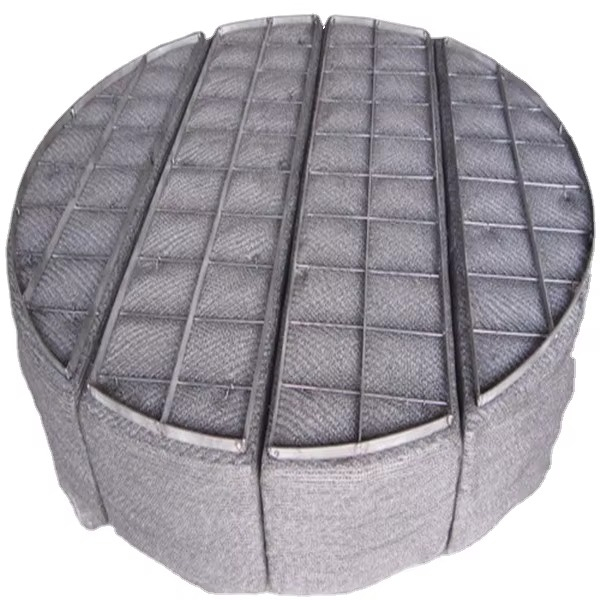
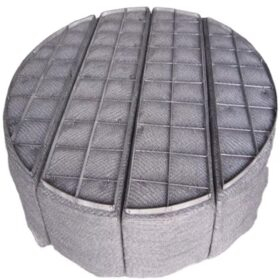
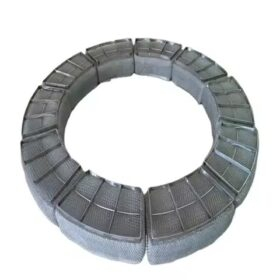
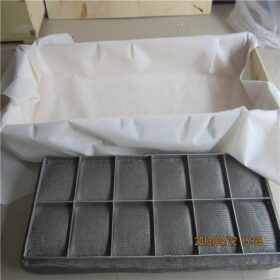

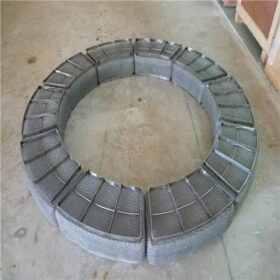
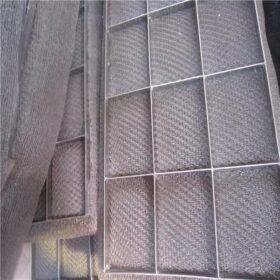
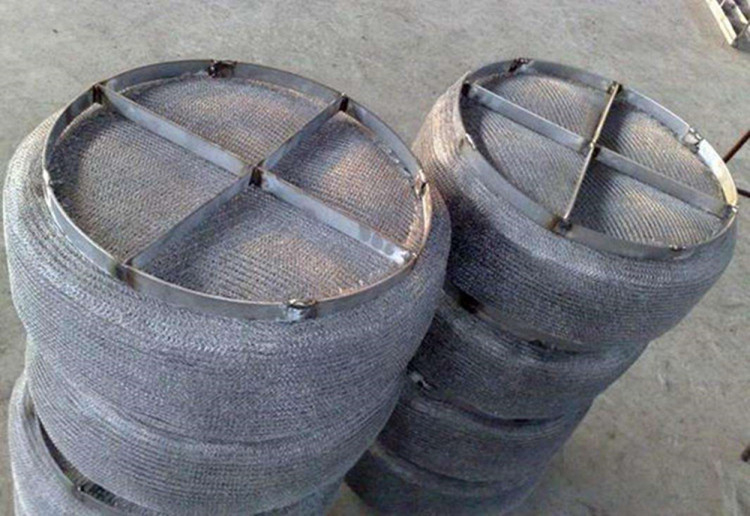
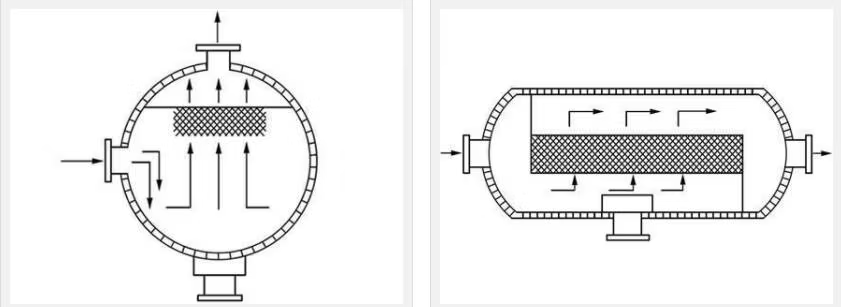
Nickel wire mesh demister pads (also called mist eliminators or wire-mesh separators) are knitted layers of nickel wire formed into a pad and supported by grids. Installed at the top of process vessels, columns, and scrubbers, they coalesce fine liquid droplets from gas streams—cutting entrainment, protecting downstream equipment, and improving product purity. Choosing nickel (typically Nickel 200/201) gives excellent resistance to caustic and alkaline media, dependable high-temperature performance, and long, stable service life where standard stainless steels may struggle.
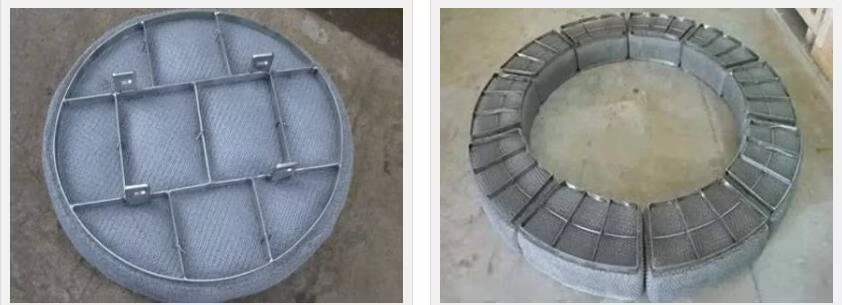
Applications
Nickel wire mesh demister pads are used across processes where corrosion resistance in alkaline or reducing environments matters and droplet control is critical, including:
- Evaporators & crystallizers (e.g., caustic soda/potash units) to prevent brine carryover.
- Absorbers & scrubbers (acid gas, ammonia, amines—when nickel compatibility is suitable) to reduce solvent losses.
- Distillation/fractionation columns to improve tray/packing efficiency and overhead purity.
- Knock-out drums & separators upstream of compressors, vacuum systems, and instrumentation.
- Vent control on storage tanks and reactors to limit condensate entrainment.
Always confirm media compatibility—nickel excels in caustic/alkaline and many reducing conditions but is not ideal in strongly oxidizing environments.

Benefits Nickel wire mesh demister pads
- High separation efficiency: Typically ≥99% removal for droplets ≥3–5 μm, reducing product losses and protecting downstream equipment.
- Low pressure drop: Open, knitted structure minimizes ΔP and energy use versus more restrictive internals.
- Thermal & corrosion resistance: Nickel resists caustic stress-corrosion cracking and performs well at elevated temperatures.
- Compact & lightweight: High efficiency in a small envelope; easy retrofit into existing vessels.
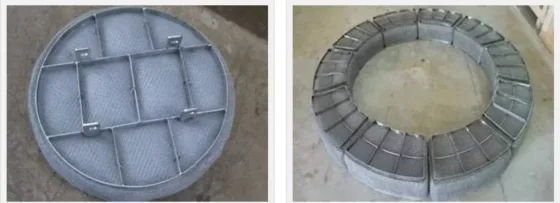
- Easy to fabricate & service: Supplied in one-piece or segmented rings for manway installation; simple to clean or replace.
Standard (Specifications & Options)
Below are common, practical “standards” and choices used when specifying nickel wire mesh demister pads. Values can be tuned to your duty.
Materials
- Mesh: Nickel 200 / Nickel 201 knitted wire.
- Support grids/rings: Nickel, 304/316 stainless, or other alloys to suit the service.
- Documentation: Mill certificates (e.g., EN 10204 3.1) typically available.
Typical construction
- Pad thickness: 100 mm (4 in) standard; 150–200 mm (6–8 in) for higher efficiency/low K-values.
- Bulk mesh density: ~80–200 kg/m³ (lower for capacity, higher for efficiency).
- Wire diameter: ~0.10–0.28 mm (balanced for surface area vs. pressure drop).
- Specific surface area: commonly 300–700 m²/m³, depending on density and wire size.
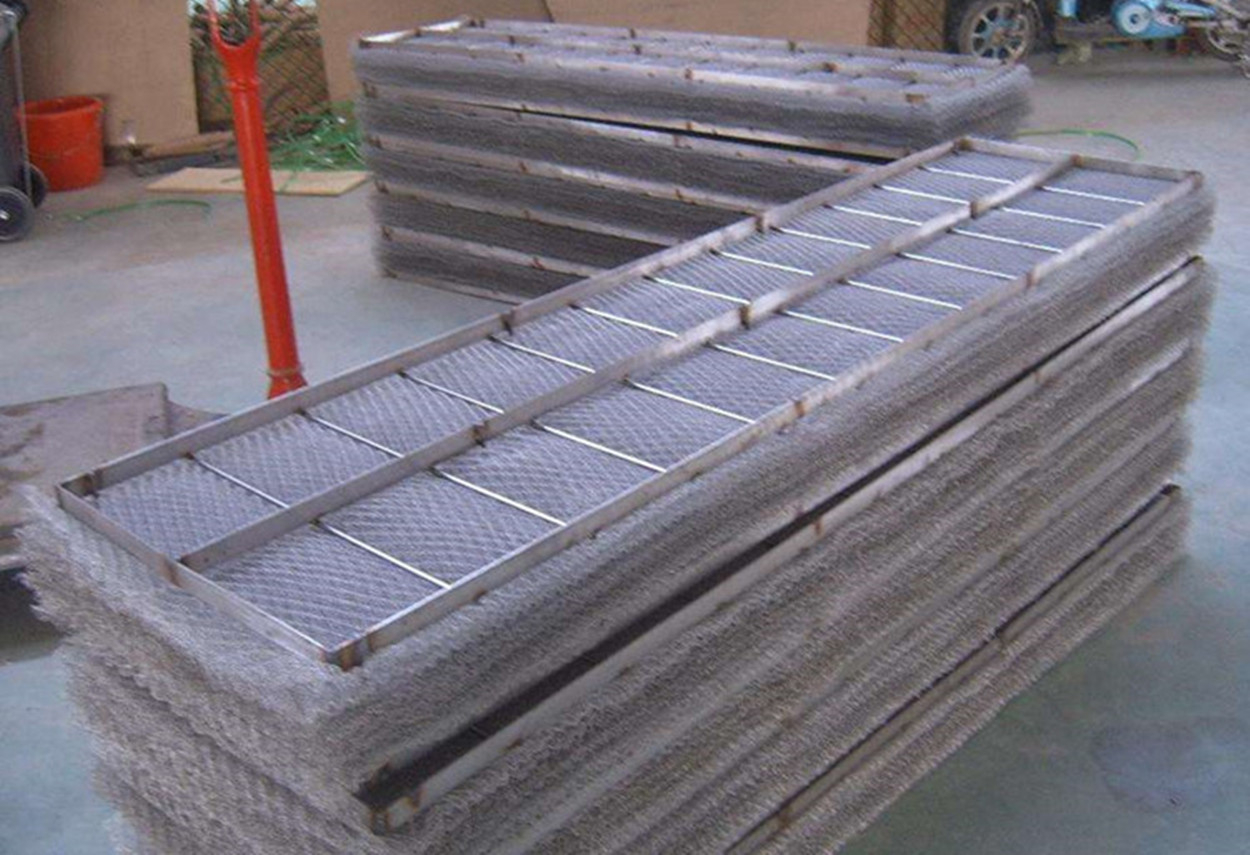
- Segmenting: One-piece (for large manways) or multi-segment with keyed orientation; radial and circumferential joints laced or hooked.
- Supports: Upper/lower grids (flat or formed) with tie-wires, beams, or cleats; hold-down bars for high-velocity service.
Performance guidelines
- Droplet removal: Typically ≥3–5 μm with efficiencies ≥99% in well-designed services.
- Design capacity factor (K-value): Often sized around 0.10–0.35 m/s (0.35–1.15 ft/s) depending on system properties and target efficiency.
- Allowable velocity: Derived from K·√((ρL–ρG)/ρG); verify for foaming, viscosity, and surface tension effects.
Quality references (commonly applied)
- Material chemistry and mechanicals for Nickel 200/201 wire generally aligned with ASTM B160 (rod/bar/wire) and related nickel product specs; plate/sheet for supports often per ASTM B162.
- Fabrication and inspection under an ISO 9001 QMS; traceability by heat/lot number.
(Exact codes/standards can vary by project—confirm with your EPC/specifier.)
 |  |
 |  |
 |  |
Specifications Nickel wire mesh demister pads
1) Materials (mesh & support options)
| Material (mesh) | Typical use notes |
|---|---|
| Nickel (Ni 200/201) | Focus alloy; excellent in alkaline/reducing media, good high-T stability |
| Pure titanium (Ti) | Chloride/brine resistance; lightweight |
| Tantalum | Strong acids / highly corrosive media (premium) |
| Monel 400 | Brine/HF/HCl (reducing) resistance |
| Molybdenum | High-T strength, specialty services |
| Ti–Cu | Anti-biofouling niche |
| Stainless steels (304/316, etc.) | General duty / supports |
| Special alloys | On request per process |
| Support grids/rings | Nickel, SS304/316, or matched alloy |
2) Dimensions & construction
| Parameter | Standard / Range |
|---|---|
| Nominal diameters | DN100 – DN4000 (larger on request) |
| Standard thickness | 100 mm (typ.), 150–200 mm for higher efficiency / low K |
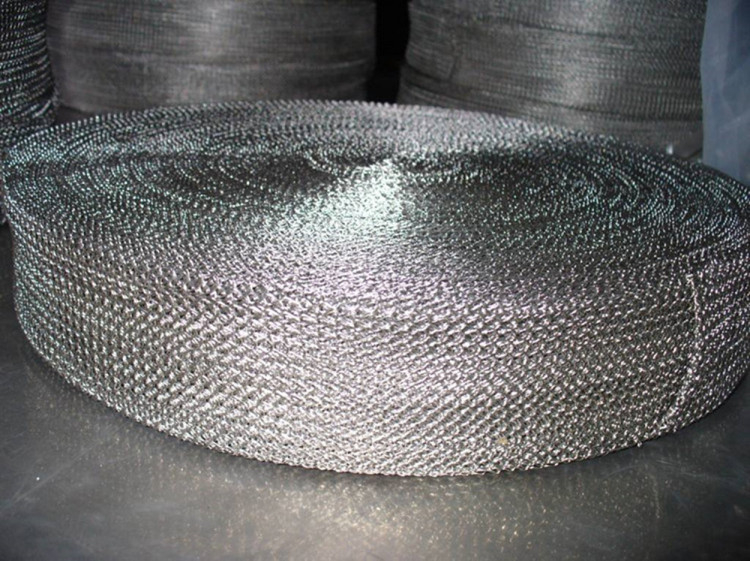
| Pad composition | Multi-layer knitted mesh “mats” (flat or corrugated) + spacers, retained by upper/lower support grids |
| Segmentation | One-piece (large manway) or multi-segment with keyed orientation; laced/hooked joints |
| Wire diameter (typ.) | ~0.10–0.28 mm (flat or round wire) |
| Bulk mesh density (typ.) | ~80–200 kg/m³ (duty-dependent) |
| Specific surface area (typ.) | ~300–700 m²/m³ (geometry-dependent) |
3) Performance & design guidelines (typical)
| Criterion | Guidance |
|---|---|
| Design cut size | ≥ 3–5 μm droplets (standard knitted mesh) |
| Separation efficiency | ≥ 99% for ≥3–5 μm with proper sizing |
| Sizing velocity | V=K(ρL−ρG)/ρGV = K \sqrt{(\rho_L-\rho_G)/\rho_G} |
| K-value (clean service) | 0.10–0.35 m/s (0.35–1.15 ft/s), derate for foaming/viscosity |
| Clean pressure drop | ~100–400 Pa per 100 mm at design velocity (duty-dependent) |
| Temperature | As allowed by alloy (Nickel: broad high-T capability) |
4) Types & representative specifications Nickel wire mesh demister pads
Standard Type (STWM)
| Item | Wire type | Wire size (mm) | Wire width tolerance (mm) | Bulk density (kg/m³) | Specific surface area (m²/m³) | Porosity | Layers / 100 mm |
|---|---|---|---|---|---|---|---|
| STWM-01 | Flat | 0.10 × 0.40 | +10 / −0 | 150 | 475 | 0.981 | 25 |
| STWM-02 | Round | Ø0.23 | — | — | 320 | — | 25 |
Efficient Type (ETWM)
| Item | Wire type | Wire size (mm) | Wire width tolerance (mm) | Bulk density (kg/m³) | Specific surface area (m²/m³) | Porosity | Layers / 100 mm |
|---|---|---|---|---|---|---|---|
| ETWM-01 | Flat | 0.10 × 0.30 | +10 / −0 | 182 | 626 | 0.977 | 32 |
| ETWM-02 | Round | Ø0.19 | — | — | 484 | — | 32 |
High-Penetration Type (HTWM)
| Item | Wire type | Wire size (mm) | Wire width tolerance (mm) | Bulk density (kg/m³) | Specific surface area (m²/m³) | Porosity | Layers / 100 mm |
|---|---|---|---|---|---|---|---|
| HTWM-01 | Flat | 0.10 × 0.40 | +10 / −0 | 98 | 313 | 0.9875 | 20 |
| HTWM-02 | Round | Ø0.23 | — | — | 4217 [verify] | — | 20 |
Note: Cells shown as “—” were not specified in your source data. The HTWM-02 surface-area value appears unusually high; please confirm during order engineering.
Shock-Absorber Type
| Item | Specification | Filament spec (mm) |
|---|---|---|
| STWM-01 | 33-30 type | 0.08 |
| STWM-02 | 38-40 type | 0.08 |
| STWM-03 | 20-40 type | 0.22 |
| STWM-04 | 30-40 type | 0.10 / 0.12 |
| STWM-05 | 30-50 type | 0.16 |
| STWM-06 | 40-60 type | 0.12 |
| STWM-07 | 30-80 type | 0.22 |
| STWM-08 | 50-120 type | 0.22 |
| STWM-09 | 40-120 type | 0.22 |
Packing Nickel wire mesh demister pads
To ensure the integrity of nickel wire mesh demister pads from shop to site:
- Protection: Pads wrapped in polyethylene film or VCI paper, then cushioned; edges guarded to prevent deformation.
- Crating: Export-grade plywood cases or steel-bound crates; segments nested and separated with corrugated or foam spacers.
- Identification: Durable tags showing item/PO, vessel/Nozzle location, orientation, segment map, size, alloy, heat numbers.
- Documentation inside: Packing list, installation guide, inspection record, material certificates.
- Handling notes: “Keep Dry,” “Do Not Stack,” and lift points marked; larger pads shipped on pallets with banding.
Using method of demisters
Mesh pad installation
There are two kinds of wire mesh demister pad, which are disk shaped demister pad and bar type demister pad.
According to different using condition, it can be divided into upload type and download type. When the opening is located in the above of the demister pad or when there is no opening but has flange, you should choose the upload demister pad.
When the opening is in the below of the demister pad, you should choose the download type demister pad.
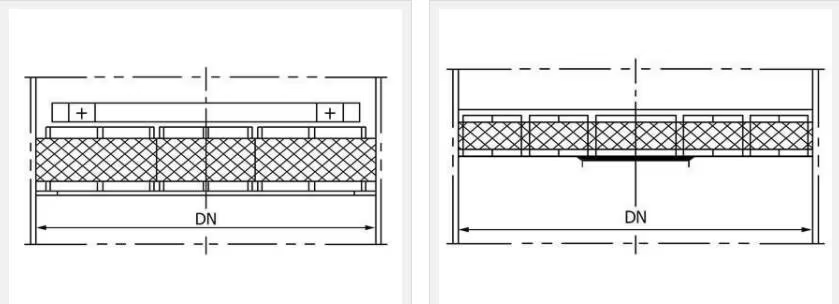
Schematic of demister pad


Maintenance of demister pad
After using for a long time, the demister pad will clog or prone to flooding and the pressure drop will increase. All these because of the particles in the gas blocks the demister pad. So you need maintain the demister pad properly and regularly.
Maintenance method: clean the demister pad. As we all know, the dilute acid on the demister pad will shorten the service life of demister pad, so we should place the demister pad in the natural state or under the sunlight
FAQs: Nickel Wire Mesh Demister Pads
Conclusion
Nickel wire mesh demister pads deliver reliable, high-efficiency mist removal where alkaline corrosion resistance and temperature stability are essential. With proper material selection (Nickel 200/201), right-sized mesh density and thickness, and correctly engineered supports, they offer low pressure drop, long service life, and clean overheads—improving plant uptime and product quality.
If you’d like, share your gas/liquid, flow rate, operating pressure/temperature, and target droplet size, and I’ll draft a quick datasheet (thickness, density, K-value, and estimated ΔP) tailored to your service.