Your One-Stop Wire Mesh Fence Supplier | POLYMETAL


Temporary fence with block is the fastest way to build a controlled boundary on active sites, but it is also one of the easiest systems to “look fine” while quietly failing under wind shifts, uneven ground, and daily vibration. A temporary fence line only performs as well as its base block: if the block slides, rocks, cracks, or loosens couplers, the entire run starts walking out of alignment.
The dangerous part is that many blocks appear similar in photos, yet behave very differently after installation. A small downgrade in HDPE wall thickness, concrete fill discipline, UV additive level, clamp spacing, or pipe fit can turn a simple fence job into rework, disputes, and safety exposure.


HDPE 5502 Blow Moulding Temporary Fence Base Block (600×220×130mm) — Concrete Fill — UV531 High Treatment
POLYMETAL supplies blow moulded HDPE temporary fence base blocks designed for AU/NZ site handling realities. Compared with many market options, the base shell weight is built heavier for better impact tolerance and longer service life, and the common supply format is factory concrete-filled to simplify site setup and reduce inconsistent on-site filling—making it a strong match for Australian temporary fencing projects that demand fast deployment and reliable stability.
In practical handling conditions, a stronger base shell reduces crack risk during unloading, stacking, and repositioning, and it helps maintain clamp geometry so panels sit straighter and couplers stay tighter over long runs.


Why the Block Matters in a Temporary Fence with Block System
A temporary fence with block succeeds or fails for three simple reasons: the base must resist sliding, resist rocking, and hold its pipe sockets and clamp positions under repeated micro-movement. If the block footprint, weight distribution, or pipe fit is wrong, panels start drifting, couplers loosen, and the line develops visible wave patterns that trigger complaints and rework.
Processing Flow
HDPE blow moulding → Trimming and socket inspection → UV additive verification →MPA425 Concrete filling (if required) → Curing and weight check → Clamp spacing verification → Packaging → Container loading


Top 10 Shocking Traps Buyers Miss When Ordering Temporary Fence with Block
These are the issues that trigger instability, failures, and cost blowouts on real projects. The biggest loss most buyers experience usually happens when blocks are already on site and the fence line must be rebuilt—especially Trap #7.


Trap #1: The “Weight Illusion” Problem
Two blocks can look identical, but a lighter shell or inconsistent fill creates easier sliding and faster rocking. A few kilograms of difference can change stability across an entire long run, especially on smooth concrete or high-traffic corridors.
Trap #2: Thin HDPE Shell That Cracks Early
A weak shell fails first at corners, sockets, and lift edges during unloading and repositioning. Once the shell cracks, water ingress and fill breakdown accelerate, and the block becomes a recurring failure point.
Trap #3: UV Additive Weakness That Becomes a Maintenance Crisis
If UV stabilisation is under-specified, the base can become brittle and chalky under sun exposure, leading to cracking, socket deformation, and premature replacement costs across the site.
Trap #4: Bad Concrete Fill Discipline
Inconsistent fill density creates unpredictable weights and balance, so the fence line behaves differently bay-to-bay. That inconsistency increases coupler loosening, alignment drift, and trip hazards.
Trap #5: Clamp Spacing Mismatch That Forces Site Improvisation
Clamp spacing must match the fence panel and pipe socket geometry. If the spacing is wrong, installers force-fit panels, which increases stress on sockets and triggers loosening under vibration.
Trap #6: Pipe Fit That Is Too Loose (The Fence “Walks”)
If pipe sockets are oversized or inconsistent, posts wobble under wind and repeated contact. That wobble translates into coupler movement and fence drift, especially when trucks and forklifts pass nearby.
Trap #7: Ground Reality Ignored (The Biggest Cost Loss Trigger)
This is where buyers lose the most money. If the site includes slopes, soft edges, drainage fall, or mixed surfaces, the wrong block footprint and wrong weight plan cause rocking and sliding that cannot be “tightened away.” Installers then add ad-hoc bracing, reposition blocks repeatedly, or rebuild runs entirely, which burns labour and delays handover.
Trap #8: Socket Layout That Cannot Handle Corner Loads
Corners, gates, and ends amplify loads. If the block design cannot handle corner tension, the line opens gaps and panels rack out of square, which looks bad and fails inspection.
Trap #9: Packing That Lets Blocks Rub and Deform
Poor packing causes socket edges to rub, clamps to deform, and corners to crack during shipping. Damage often appears “minor” at arrival but becomes failure later under daily movement.
Trap #10: No Label Discipline (Wrong Block in the Wrong Run)
Mixed heights and mixed clamp options require clear labels. Without it, installers place incompatible blocks in critical runs, and the fence becomes uneven, loose, and rework-heavy.
Product Description (POLYMETAL)
POLYMETAL temporary fence with block solutions use blow moulded HDPE base shells designed for durable site handling, with concrete-filled options to deliver stable weight and faster deployment. The base geometry is engineered to hold temporary fence pipes securely while supporting consistent clamp alignment, helping fence panels remain straight and reducing the cycle of coupler loosening caused by micro-movement.
For AU/NZ projects, the base configuration is commonly selected around pipe OD compatibility, clamp centre-to-centre spacing, UV stabilisation expectations, and post alignment discipline. When these details are specified correctly, the fence line installs faster, stays straighter, and resists the sliding and rocking that trigger costly rework.
Specifications — Blow Moulding Base Version (HDPE Materials)
| Item | Version A | Version B | Version C |
|---|---|---|---|
| Size | 600 × 228 × 150mm | 620 × 230 × 130mm | 600 × 228 × 150mm |
| Material | HDPE 5502 | HDPE 5502 | HDPE 5502 |
| Finish / UV | UV 2002 / 531 BHT | UV 2002 / 531 BHT | UV 2002 / 531 BHT |
| Colours | Orange, Green, Yellow, etc. | Orange, Green, Yellow, etc. | Orange, Green, Yellow, etc. |
| Weight | After filled: 27–29kg | After filled: 27–28kg | After filled: 29kg |
| Design | Australia | Australia | Australia |
| Clamp | 100mm centre-to-centre | 90mm centre-to-centre | 80mm |
| Suit Pipes | OD 32mm / OD 38mm / OD 40mm / OD 42mm / OD 48mm | ||
| Photos | 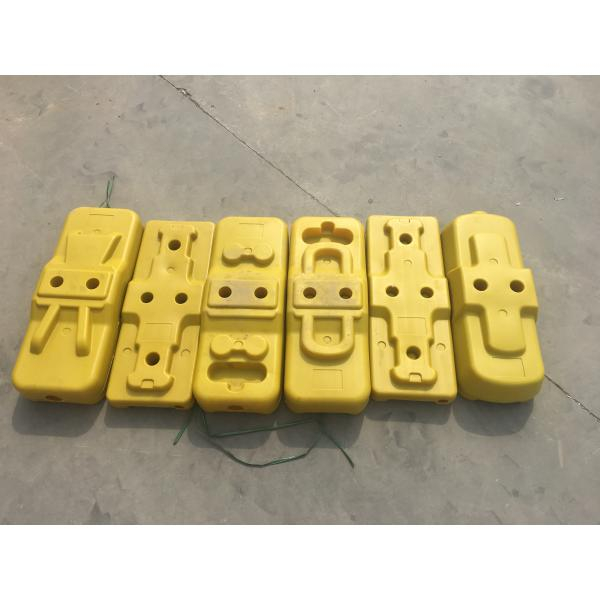 |  | |
Applications
- Construction site boundaries and access control runs
- Pedestrian diversion corridors and event crowd separation
- Warehouses, yards, and temporary storage protection
- Roadworks and utility zones requiring quick install and relocation
- Short-term hazard exclusion areas and controlled entry points
Benefits
- Faster setup: concrete-filled options reduce on-site preparation and improve consistency.
- Stronger handling: heavier shell design helps resist cracks and socket deformation during site movement.
- Better alignment: stable blocks reduce rocking, helping panels stay straighter over long runs.
- Lower rework risk: correct clamp geometry and pipe fit reduce coupler loosening cycles.
- UV resilience: UV-treated finish supports longer service life under sun exposure.
Packing
POLYMETAL packing is designed to reduce rubbing damage, socket deformation, and corner impacts that cause early failures on site.
- Base blocks stacked with separation protection to reduce surface abrasion and edge cracking.
- Bundled and palletised for forklift handling and faster receiving checks.
- Clear labels by size, clamp option, and weight class to prevent mix-ups across runs.
- Custom packing available to match container loading plan and site unloading method.


Standard
A temporary fence with block system should be selected to match site wind exposure, ground condition, and safety management requirements. The safest procurement method is to specify measurable performance targets such as minimum filled weight, socket tolerance, clamp spacing, UV treatment level, and packing protection rules so the delivered blocks behave consistently across the entire project.

FAQs
Q1: What is the fastest way to choose the correct temporary fence with block option?
A: Start with your pipe OD, required clamp spacing, and filled weight target, then match the block footprint to your ground condition and wind exposure.
Q2: Can the blocks be supplied empty or concrete-filled?
A: Yes, both formats can be supplied, and concrete-filled options are commonly used to reduce site variation and speed up deployment.
Q3: Which clamp option should I choose?
A: Choose the clamp centre-to-centre spacing that matches your fence panel and site hardware to avoid forced installation and loosening issues.
Q4: What colours are available?
A: Orange, green, yellow, and other colours can be supplied based on project needs.
Q5: How do you reduce shipping damage?
A: Separation protection, correct stacking, pallet discipline, and clear labels prevent rubbing, corner impacts, and socket deformation.