Your One-Stop Wire Mesh Fence Supplier | POLYMETAL




What Is Stainless Steel Rope Mesh?
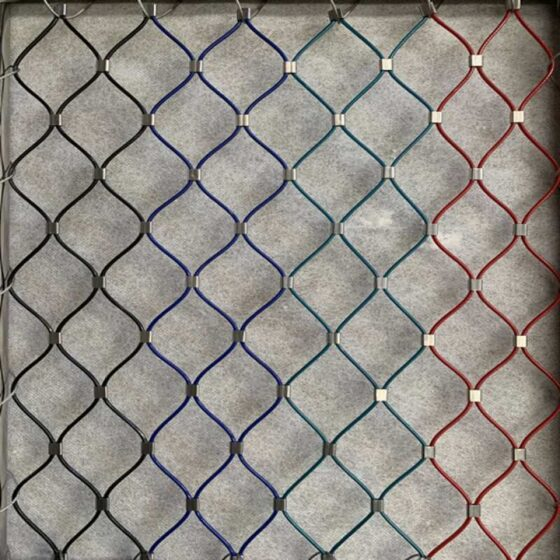
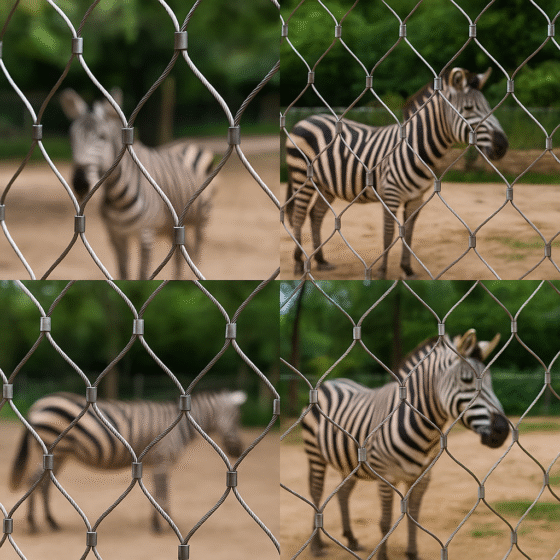
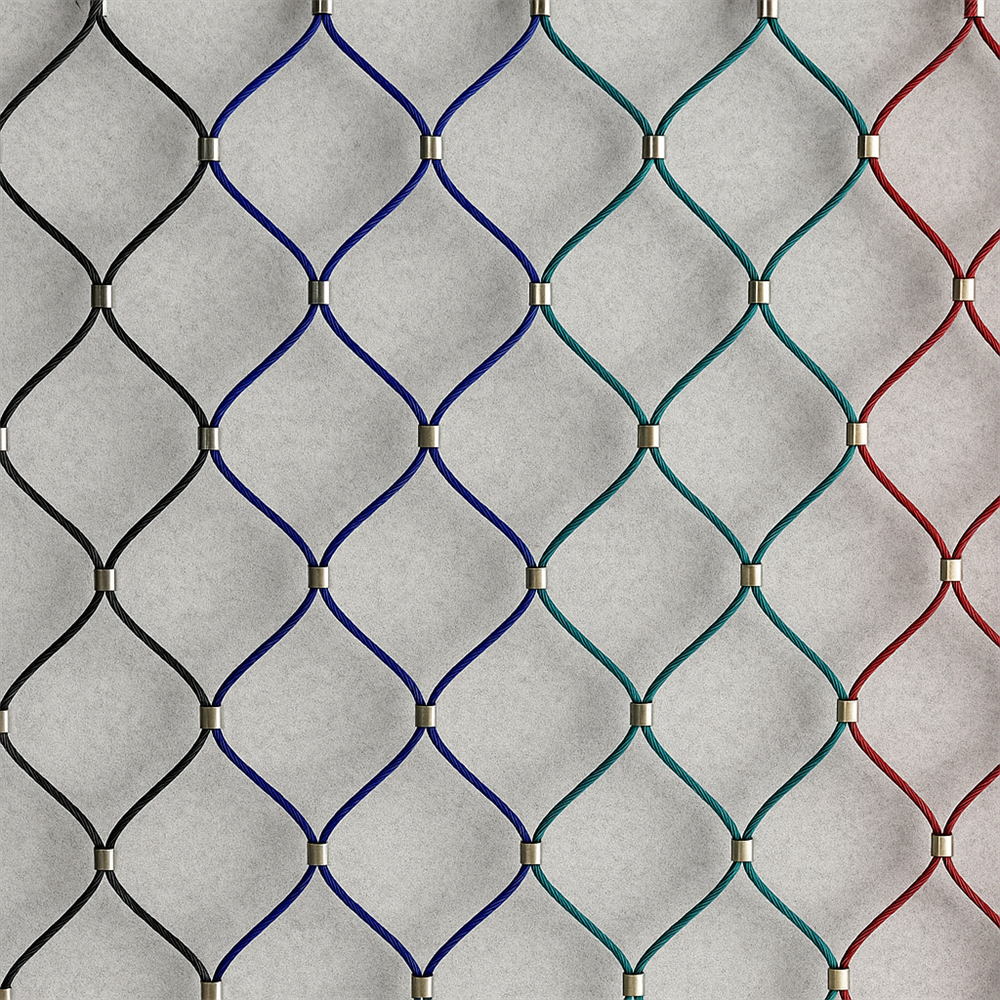
Stainless steel rope mesh is a flexible net woven from multi-strand wire ropes (commonly 7×7 or 7×19 constructions). Intersections are secured either by hand-woven “knots” (plain or knotted weave) or by stainless ferrules (knotless ferrule connection). The diamond-shaped apertures can be tailored—from tight patterns for small birds to wider modules for large animals or architectural infills—so designers can balance safety, transparency, and climb-resistance.

Why Zoos and Architects Prefer It
- Rust-free longevity: Stainless steel resists corrosion and requires minimal maintenance, even outdoors.
- High strength & impact resistance: Multi-strand ropes and engineered terminations absorb loads from animals and visitors.
- Recyclable & durable: A long service life plus full recyclability supports sustainability goals.
- Design flexibility: The mesh curves and spans organically, enabling large, unobstructed enclosures and elegant architectural lines.
- Excellent visibility: Fine cables and slender ferrules create an “almost invisible” barrier that preserves views and visitor experience.
Common Applications
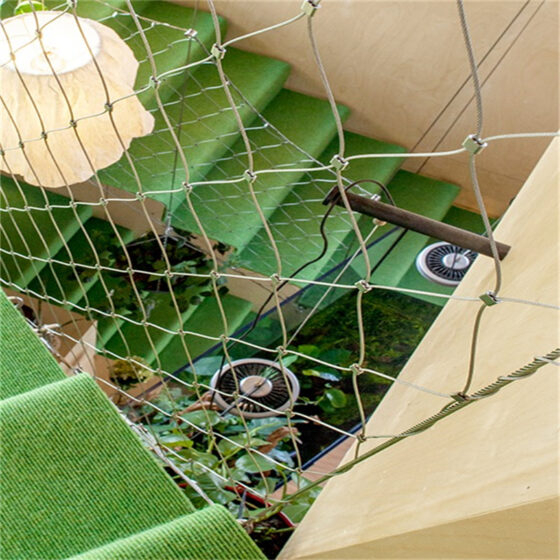
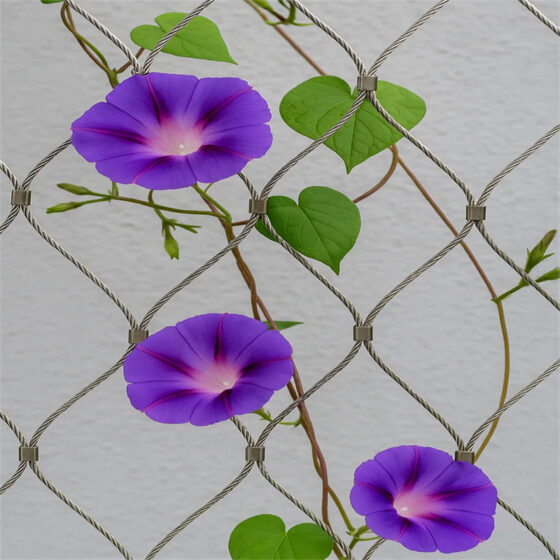
In animal care, stainless rope mesh excels as zoo wire mesh for lions, tigers, monkeys, primates, and large birds. In architecture, it appears in balustrades and handrail infill, fall-protection on bridges and observation decks, green wall trellises, window guards, and decorative partitions. Because it is both pliable and strong, one system can serve multiple uses across a single project.

Choosing Weave Type, Aperture, and Cable Diameter
Two popular build styles are:
- Plain/knotted weave: Wire ropes are hand-woven and locked at each intersection, producing a supple mesh with a classic diamond pattern.
- Knotless with ferrules: Stainless ferrules swage the cables together, yielding a tidy, uniform look and excellent dimensional stability.
Aperture (mesh opening) and cable diameter work together. For parrots and small-to-medium birds, tighter apertures (≈25–51 mm / 1–2 in) and finer cables (≈1.2–1.6 mm) prevent escapes and reduce beak damage. Big-cat or primate enclosures often use 50–76–102 mm apertures (2–3–4 in) paired with 2.0–3.2 mm cables to safely resist pawing and climbing. For balustrade infill, the goal is code compliance and anti-climb behavior while keeping sightlines open.
General Specifications Stainless steel rope mesh
| ZOO MESH / ANIMAL ENCLOSURE & CAGE | |||||||
| ANIMAL | ITEM | ROPE CONSTRUCTION | ROPE DIA. | MESH OPENING | NORMAL BREAK | ||
| Inch | mm | Inch | mm | Lbs. | |||
| Tiger Enclosure | POLYMETAL2476S | 7×7 | 3/32 | 2.4 | 3”×3” | 76×76 | 920 |
| POLYMETAL2410S | 7×7 | 3/32 | 2.4 | 4”×4” | 102×102 | 920 | |
| POLYMETAL3251S | 7×19 | 1/8 | 3.2 | 2”×2” | 51×51 | 1600 | |
| POLYMETAL3276S | 7×19 | 1/8 | 3.2 | 3”×3” | 76×76 | 1600 | |
| POLYMETAL3210S | 7×19 | 1/8 | 3.2 | 4”×4” | 102×102 | 1600 | |
| Lion Enclosure | POLYMETAL2476S | 7×7 | 3/32 | 2.4 | 3”×3” | 76×76 | 926 |
| POLYMETAL2410S | 7×7 | 3/32 | 2.4 | 4”×4” | 102×102 | 926 | |
| POLYMETAL3251S | 7×19 | 1/8 | 3.2 | 2”×2” | 51×51 | 1600 | |
| POLYMETAL3276S | 7×19 | 1/8 | 3.2 | 3”×3” | 76×76 | 1600 | |
| POLYMETAL3210S | 7×19 | 1/8 | 3.2 | 4”×4” | 102×102 | 1600 | |
| Leopard Enclosure | POLYMETAL2476S | 7×7 | 3/32 | 2.4 | 3”×3” | 76×76 | 920 |
| POLYMETAL2410S | 7×7 | 3/32 | 2.4 | 4”×4” | 102×102 | 920 | |
| POLYMETAL3251S | 7×19 | 1/8 | 3.2 | 2”×2” | 51×51 | 1600 | |
| POLYMETAL3276S | 7×19 | 1/8 | 3.2 | 3”×3” | 76×76 | 1600 | |
| POLYMETAL3210S | 7×19 | 1/8 | 3.2 | 4”×4” | 102×102 | 1600 | |
| Wolf Enclosure | POLYMETAL3251S | 7×19 | 1/8 | 3.2 | 2”×2” | 51×51 | 1600 |
304 vs. 316 Stainless: Which Grade to Specify?
Grade 304 is widely used and cost-effective for inland or dry environments. Grade 316, alloyed with 2–3% molybdenum, offers superior resistance to chlorides and acidic atmospheres—making it the smarter choice for coastal zoos, aquariums, splash-zones, or industrial areas. In short: use 304 for general conditions; step up to 316 when salt, humidity, or chemicals are factors.

Strength Basics and Safety Factors
Typical cable constructions—like 7×7 at 2.4 mm (3/32 in) or 7×19 at 3.2 mm (1/8 in)—carry substantial minimum breaking loads (MBL). Actual system capacity depends on the whole assembly (mesh geometry, edge cables, frames, anchors, and installation quality). Always apply appropriate safety factors and follow local codes; reputable suppliers publish MBL tables for each diameter and construction to guide selection.
Spec Examples Customers Often Order
- Aviaries for parrots: SS304, 1.2 mm cable, ~1 in (25 mm) aperture, ~0.5 kg/m².
- Primate or mixed-species habitats: SS304/316, 2.0 mm cable, 50 mm aperture.
- Large predators or impact-prone zones: SS316, 3.2 mm cable, 50–76 mm aperture.
- Aquarium and marine settings: SS316 preferred for chloride resistance (sea-lion and penguin enclosures).
Installation Pointers Stainless steel rope mesh
- Frame & edge cables: Use rigid frames or tensioned perimeter cables to distribute loads evenly.
- Pre-tension & shaping: Pre-tension mesh to eliminate slack and achieve the intended surface curvature.
- Interface protection: Add sleeves/liners at hard edges; avoid sharp contact points.
- Maintenance: Rinse periodically in coastal sites; inspect swages, ferrules, and anchors on a schedule.