Your One-Stop Wire Mesh Fence Supplier | POLYMETAL
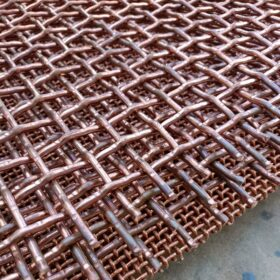
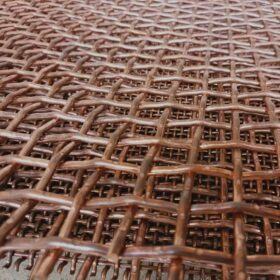
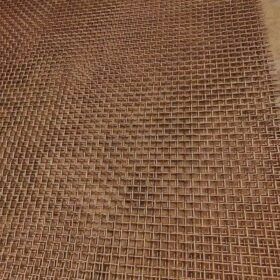
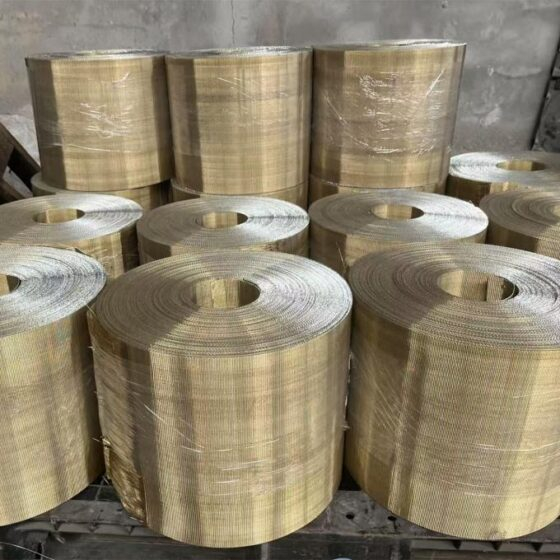
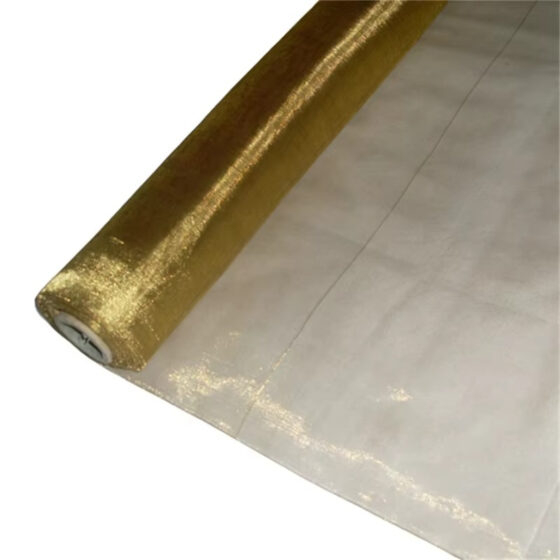
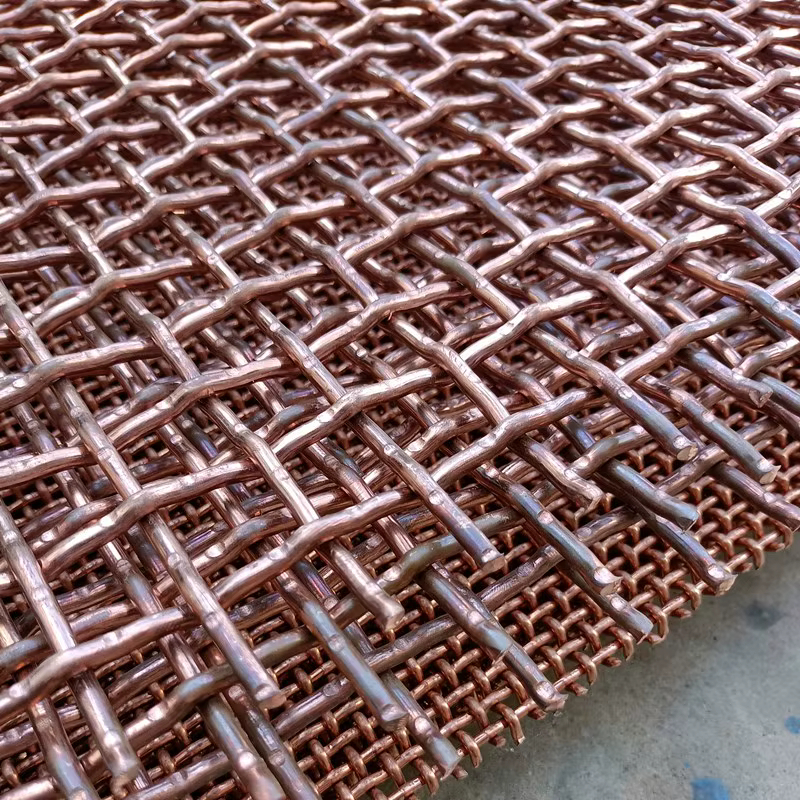
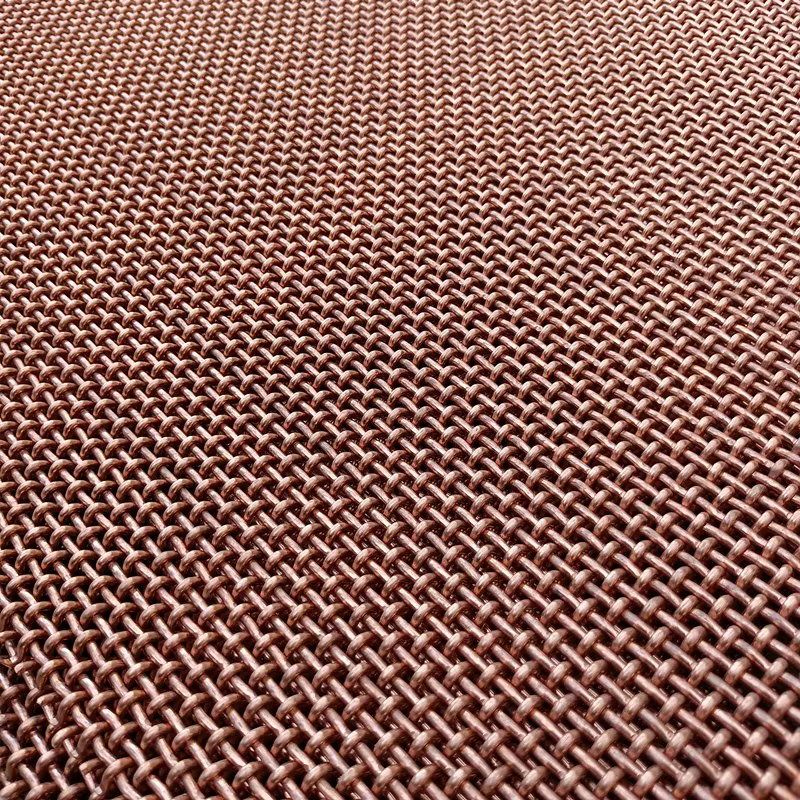
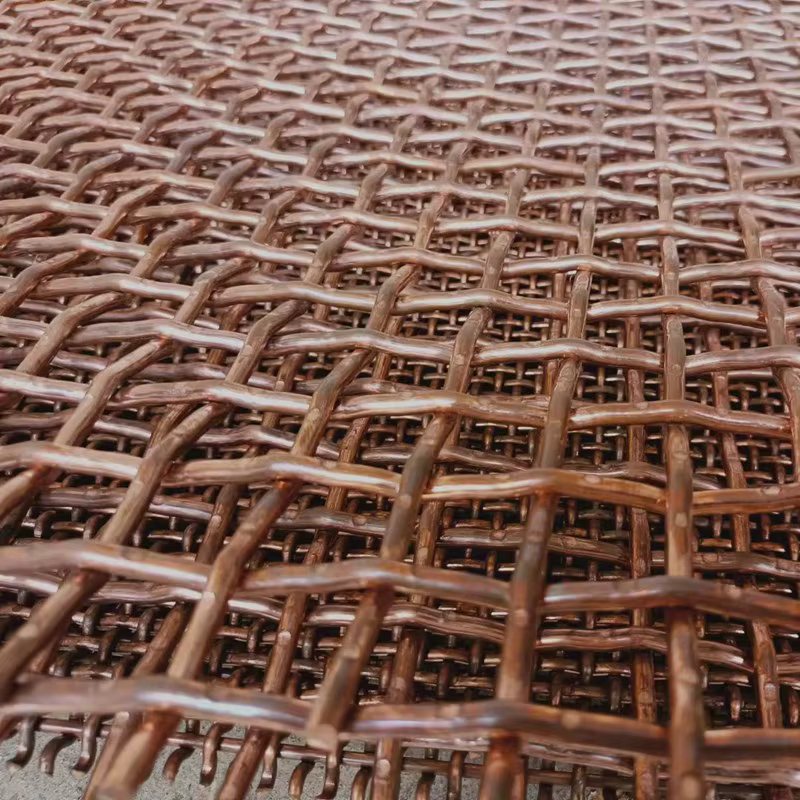
Copper Crimped Wire Mesh is a pre-crimped, woven wire screen made from high-conductivity copper wire. Each wire is crimped before weaving to lock the intersections, delivering stable apertures, a textured surface, and superior dimensional control compared with plain square mesh. Typical alloys are C110 (ETP copper, ~100% IACS conductivity) for general use and C101/C102 (OFE/OF copper) when hydrogen embrittlement resistance or maximum conductivity is required. Mesh is supplied as rolls or flat panels, in single, double, intermediate, lock-crimp, and flat-top patterns to suit strength, openness, and appearance.
Applications Copper Crimped Wire Mesh
- EMI/RFI shielding & grounding: conductive screens for vents, doors, and instrument panels where airflow and attenuation are both required.
- Architectural & decorative metalwork: grills, cabinet and radiator covers, partitions, feature ceilings/walls—chosen for its warm copper tone and 3D texture.
- Filtration & sieving (non-aggressive media): pre-filters, baskets, and strainers in labs, ceramics, plastics, and food-adjacent handling (check local compliance).
- Acoustics & speakers: protective grilles and diffusion elements where conductivity and aesthetics matter.
- Heat exchange & thermal management: radiant shields and airflow screens—copper’s thermal and electrical conductivity aid dissipation and bonding.
- Craft, restoration & heritage builds: period-correct screens and restoration parts with natural patination.
Pictures showing of Copper intermediate crimped wire mesh
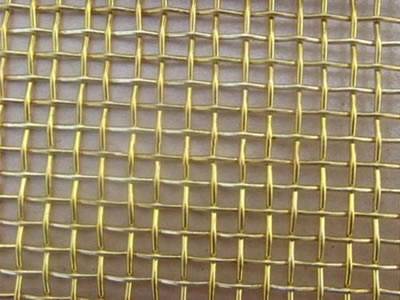 | 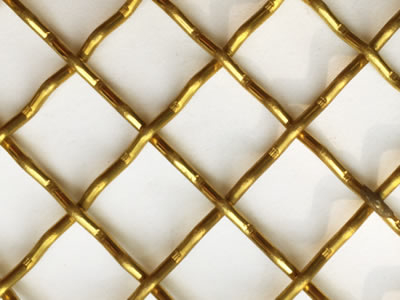 |
| Brass-double-crimped-mesh | Brass-intermediate-crimped-wire-mesh |
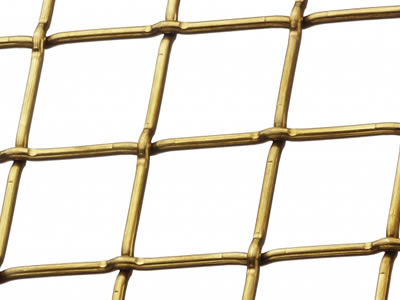 | 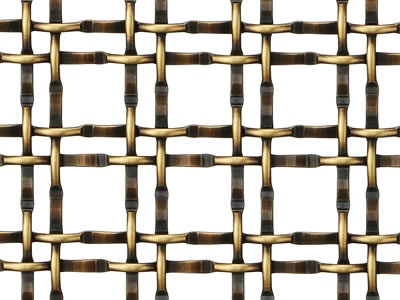 |
| Brass-lock-crimped-mesh | Double-brass-lock-crimped-mesh |
 |  |
| Copper-lock-crimped-mesh | Copper-double-crimped-mesh |
Bnefits Copper Crimped Wire Mesh
- Excellent conductivity: ensures effective electrical bonding for EMI/RFI control and grounding.
- Mechanical stability: pre-crimping locks the weave, giving rigid panels, consistent openings, and reduced mesh creep vs. non-crimped cloth.
- High open area with strength: crimp styles let you trade off flow/visibility vs. stiffness.
- Formability & joinability: copper cuts, forms, solders, and brazes easily; edges can be hemmed or framed.
- Aesthetic performance: distinctive copper color; can be left to patinate (verdigris) or clear-coated for a bright, long-term finish.
- Versatile patterns: single, double, lock-crimp, intermediate crimp, and flat-top options cover coarse guarding to fine screens.
Standard & Specifications
When specifying Copper Crimped Wire Mesh, include:
- Material & temper: C110/C101/C102 copper; soft/annealed or hard-drawn per ASTM B3 (soft/annealed copper wire) or ASTM B1 (hard-drawn).
- Optional finishes: tinned copper per ASTM B33 (improved solderability/corrosion control), lacquer/clear coat for appearance retention.
- Mesh and wire size: mesh count (or opening), wire diameter, and crimp style (single/double/intermediate/lock-crimp/flat-top).
- Dimensional standards: ASTM E2016 (industrial woven wire cloth) and ISO 9044 (technical requirements, tolerances, inspection).
- Typical ranges (guidance):
Mesh: 2–80 mesh (coarse guarding to fine screening)
Wire diameter: 0.20–2.50 mm (custom thinner/thicker on request)
Openings: ~0.2–25 mm depending on mesh/wire
Roll widths: 1.0 / 1.22 / 1.5 / 2.0 m; standard lengths 30 / 50 m
Panel sizes: common 1000×2000 mm, 1220×2440 mm, or to drawing
- Quality documents: heat/lot traceability, dimensional/aperture reports; EN 10204 3.1 MTCs on request.
- Project notes: for low-frequency magnetic shielding (Hz–kHz), use high-μ alloys—copper excels for RF/electric fields but is not a magnetic shield.
Specifications
| Product code | Mesh | Diameter | Aperture | |||
| SWG | mm | Inch | mm | Inch | ||
| Cytd-16 | 1 | 6 | 4.8 | 0.189 | 20.6 | 0.811 |
| Cytd-28 | 2 | 8 | 4.05 | 0.159 | 9 | 0.354 |
| Cytd-210 | 2 | 10 | 3.2 | 0.126 | 10 | 0.394 |
| Cytd-312 | 3 | 12 | 2.6 | 0.102 | 5.9 | 0.232 |
| Cytd-314 | 3 | 14 | 2.0 | 0.789 | 6.5 | 0.256 |
| Cytd-416 | 4 | 16 | 1.6 | 0.063 | 5 | 0.197 |
| Cytd-517 | 5 | 17 | 1.4 | 0.055 | 5.1 | 0.201 |
| Cytd-518 | 5 | 18 | 1.2 | 0.047 | 4 | 0.157 |
| Cytd-619 | 6 | 19 | 1.0 | 0.039 | 3.2 | 0.126 |
| Cytd-622 | 6 | 22 | 0.711 | 0.028 | 3.522 | 0.139 |
| Cytd-721 | 7 | 21 | 0.8 | 0.031 | 2.8 | 0.110 |
| Cytd-822 | 8 | 22 | 0.7 | 0.028 | 2.5 | 0.098 |
| Cytd-823 | 8 | 23 | 0.61 | 0.024 | 2.565 | 0.101 |
| Cytd-824 | 8 | 24 | 0.61 | 0.024 | 2.57 | 0.101 |
| Cytd-1024 | 10 | 24 | 0.508 | 0.02 | 2.03 | 0.080 |
| Cytd-1025 | 10 | 25 | 0.508 | 0.02 | 2.032 | 0.080 |
| Cytd-1222 | 12 | 22 | 0.71 | 0.028 | 0.14 | 0.006 |
| Cytd-1226 | 12 | 26 | 0.457 | 0.018 | 1.66 | 0.065 |
| Cytd-1424 | 14 | 24 | 0.55 | 0.022 | 0.12 | 0.005 |
| Cytd-1427 | 14 | 27 | 0.417 | 0.016 | 1.4 | 0.055 |
| Cytd-1624 | 16 | 24 | 0.55 | 0.022 | 0.1 | 0.004 |
| Cytd-1629 | 16 | 29 | 0.345 | 0.014 | 1.243 | 0.048 |
| Cytd-188 | 18 | 8 | 4.05 | 0.159 | 1 | 0.039 |
| Cytd-1823 | 18 | 23 | 0.61 | 0.024 | 0.8 | 0.031 |
| Cytd-1830 | 18 | 30 | 0.315 | 0.012 | 1.096 | 0.044 |
| Cytd-2025 | 20 | 25 | 0.5 | 0.020 | 0.61 | 0.024 |
| Cytd-2030 | 20 | 30 | 0.315 | 0.0124 | 0.955 | 0.038 |
Packing Copper Crimped Wire Mesh
- Rolls: wound on rigid cores with edge guards; inner anti-tarnish/VCI wrap + desiccant; outer moisture-barrier film; labeled for alloy, mesh×wire, opening, width/length, lot/heat.
- Panels: interleaved with paper/film, corner protectors, strapped to plywood or crated in wooden boxes for export.
- Custom kits: framed screens, rim-welded discs, or pre-bent panels packed flat with foam spacers.
- Handling advice: keep dry; avoid ammonia-bearing cleaners; if patina is undesired, specify a clear lacquer or periodic maintenance.

FAQs: Copper Crimped Wire Mesh
What is copper crimped wire mesh?
Copper crimped wire mesh is a woven screen made from wires that are pre-crimped before weaving. The pre-crimps lock intersections, giving stable openings, higher rigidity, and a distinctive 3D texture.
How is it different from plain woven copper mesh?
Plain weave uses straight wires and relies on tension; crimped mesh adds defined corrugations at crossings, so apertures stay consistent and panels are stiffer—especially useful for larger openings.
What crimp styles are available?
Common patterns include single crimp, double crimp, intercrimp, lock-crimp (maximum stability), and flat-top (smooth face for airflow/visual finish).
Which copper grades are typically used?
Most often C110 (ETP copper) for high conductivity and easy soldering. C101/C102 (OF/OFHC copper) are used where ultra-low oxygen and superior ductility are needed. Tinned copper is available for improved solderability and corrosion control.
What size ranges are typical?
From coarse guards (e.g., 2–10 mesh with wire 1–3 mm) to finer screens (e.g., 20–80 mesh with wire 0.2–0.8 mm). Apertures can range roughly 0.2–25 mm, depending on mesh and wire.
Where is copper crimped mesh used?
EMI/RFI vents and windows (airflow + shielding)
Architectural panels and cabinet/radiator covers
Filtration & sieving in non-aggressive media
Speaker/equipment grilles and protective guards
Craft and restoration where authentic copper finish is desired
Is it suitable for EMI/RFI shielding?
Yes. Copper’s high conductivity makes it excellent for EMI/RFI shielding. For robust results, keep the largest opening ≤ wavelength/20 at the highest frequency of concern and ensure the mesh frame has low-impedance bonding to the enclosure.
How does it handle corrosion and patina?
Copper is corrosion-resistant but naturally tarnishes and can form a brown/green patina outdoors. If a bright finish is required, specify clear lacquer or periodic cleaning; consider tinned copper for added protection.
What finishes are available?
Bare copper, tinned copper, clear-coated copper (to slow tarnish), and custom patinated finishes for architecture. Edges can be hemmed or framed; panels can be powder-coated frames with bare-mesh centers.
How strong and rigid is it?
Crimping increases panel rigidity versus plain cloth. Lock-crimp and intercrimp styles offer the best stability for larger spans; flat-top provides a smoother face with moderate stiffness.
Can it be fabricated easily?
Yes. Copper cuts, forms, solders, and brazes readily. For clean edges use shearing, waterjet, or laser (with proper parameters). Frames can be soldered, brazed, or mechanically clamped.
What standards should I reference?
ASTM E2016 (industrial woven wire cloth terminology, tolerances, inspection)
ISO 9044 (technical requirements and test methods)
ASTM B3/B1 for copper wire supply (soft/annealed or hard-drawn)
ASTM B33 when specifying tinned copper wire
How do I specify the product clearly?
Include alloy/temper, mesh × wire diameter, crimp style, aperture or open area, panel/roll dimensions, finish/coating, tolerances, and QA documents (e.g., EN 10204 3.1).
What tolerances matter most?
Mesh count and wire diameter tolerances
Aperture/open area tolerance for airflow or screening accuracy
Flatness/warp (important for framed panels)
Overall dimensions and squareness for installation fit
What about windows and visibility?
For display/observation, choose flat-top or fine intercrimp to balance optical clarity and shielding. Finer mesh improves SE but reduces light transmission.
Is it food-related safe?
Copper can react with certain foods and chemicals. For food-adjacent applications, confirm local regulations and consider coatings, liners, or alternative alloys if required.
Any cautions for low-frequency magnetic fields?
Copper is not effective for low-frequency magnetic shielding (Hz–kHz). Use high-permeability alloys if magnetic fields are the issue; copper excels for electric/RF fields.
What are typical supply forms?
Rolls: common widths 1.0 / 1.22 / 1.5 / 2.0 m; lengths 30 / 50 m
Panels: e.g., 1000×2000 mm, 1220×2440 mm, or made to drawing
Cut parts: discs, rings, strips, framed screens
How is it packed?
Rolls on rigid cores with anti-tarnish/VCI wrap, desiccant, and moisture-barrier film
Panels with interleaves, corner protection, and wooden crates for export
Clear labels for alloy, mesh × wire, aperture, size, lot/heat number
How do I choose a crimp style?
Lock-crimp: maximum stability and consistent openings
Intercrimp: good rigidity for coarser meshes
Flat-top: smooth front face for airflow and aesthetics
Single/Double crimp: economical, general purpose
What information should I send for a quote?
Provide alloy, mesh × wire, crimp style, aperture/open area, dimensions/quantities, finish, tolerances, end use, and packing requirements. This ensures fast, accurate pricing and lead times.
Conclusion
Copper Crimped Wire Mesh delivers a rare mix of conductivity, rigidity, controllable open area, and premium aesthetics. Pre-crimped construction locks aperture geometry for dependable airflow, shielding, and screening, while copper’s workability simplifies framing, soldering, and installation. Specify alloy/temper, mesh×wire, crimp style, dimensions, finish, and standards (ASTM E2016 / ISO 9044; wire per ASTM B3/B1; optional ASTM B33 for tinned)—and choose packing appropriate to rolls or panels. With those details in place, you’ll receive mesh that installs cleanly, looks excellent, and performs predictably from architectural panels to EMI vents and precision screens.