Your One-Stop Wire Mesh Fence Supplier | POLYMETAL
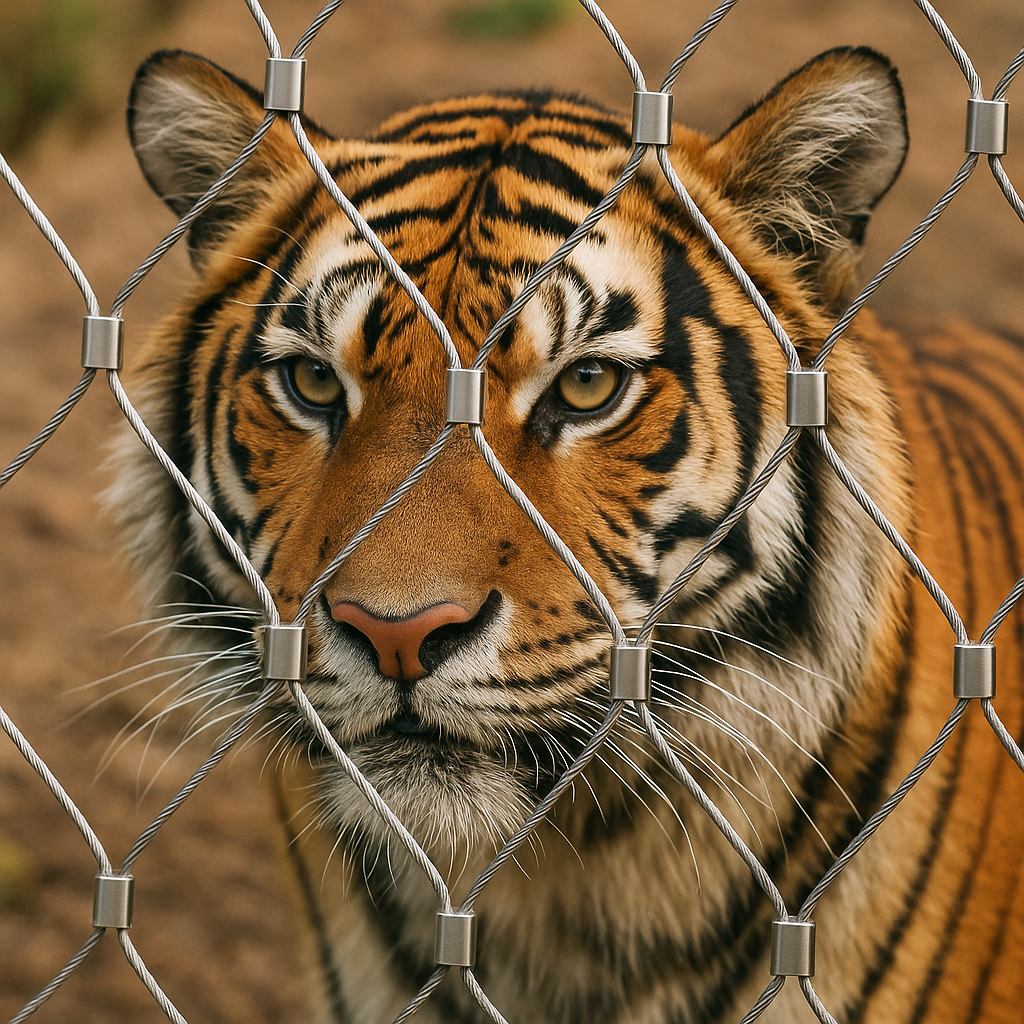


1. Design Basis: How Strong Is a Tiger?
When you design Rope mesh tiger fencing, you are really designing for a very powerful, athletic animal that can hit, climb and hang on the fence every day for many years. An adult tiger can easily exceed 200 kg, so a single jump or shoulder impact can create several kilonewtons of force on a small area of mesh. That is the starting point for all of the mesh options: every combination of aperture, wire rope diameter, material and open degree is chosen to make sure the mesh can absorb these loads safely and repeatedly, while still giving visitors a clear view. In practice, designers assume a local impact of roughly 5–8 kN spread over a few strands and the border cables, which is why all parameters are tuned together rather than chosen in isolation.
2. Wire Rope Diameter: Matching Cable Strength to Impact Zones
This basic load assumption is why many of the specifications use wire diameters from about 3.0 to 3.8 mm. A 3.0–3.2 mm stainless steel rope already has a high minimum breaking load, and a 3.8 mm rope is even stronger, so a panel made from these cables can easily share an impact of several kilonewtons between multiple strands and the surrounding frame. The Rope mesh tiger fencing thickest sizes appear in the options intended for the most demanding positions: the lower two metres of the wall, corners, jump lines and high-security perimeters. In those areas a tiger can run into the mesh at speed, launch off it, or hang on it with most of its body weight. Heavier cable diameters give a higher safety margin against both instant failure and long-term fatigue from continuous flexing. In contrast, the options using 2.4–2.7 mm cables are reserved for roofs, upper wall zones and aerial tunnels where animal pressure is lower and spans are shorter, so weight and cost can be reduced without compromising safety.
3. Mesh Aperture: Balancing Safety, Strength and Visibility
Mesh aperture is the second major design lever. At the bottom of the enclosure, the smallest apertures in the specification table, such as 51 × 51 mm or 51 × 60 mm, are chosen for both strength and welfare. A small opening means more cables per metre, which allows every impact to be distributed across more strands and keeps the tension in each individual rope lower. It also reduces the risk of a paw reaching deep through the mesh or getting twisted, and it limits how far a tiger can reach toward visitors, keeper paths or neighbouring exhibits. As you move up the wall, the specification shifts to medium apertures such as 60 × 60 mm and 64 × 64 mm. Here, the tiger still touches and climbs the mesh, but you also want a more open, visually light barrier. The larger opening improves transparency and increases the open degree, while the selected wire diameters still keep the structure strong enough for climbing and leaning. At the very top and on roof sections you see the largest apertures—70 × 70, 76 × 76, 80 × 80 or even 70 × 100 mm. These are areas where the tiger rarely hits the mesh at full speed, so the design can prioritise openness, reduced wind load and lower weight without losing overall security.
4. Materials Choice: Keeping Strength Over the Lifetime of the Exhibit
Material selection is driven by the fact that tiger strength is not a one-time load but a lifetime of heavy use. A barrier that rusts, pits or weakens after only a few years can become a real risk when a large predator is testing it daily. For that reason, the options use only stainless steel grades such as AISI 304, 304L, 316 and 316L in 7×7 or 7×19 rope constructions. In harsh, coastal or very humid environments, the 316 and 316L variants are preferred for high-impact zones because they maintain their strength and surface quality better over time. Grades 304 and 304L can be used in drier climates or in less exposed areas where corrosion risk is lower. The goal is to ensure that corrosion never becomes the weak point under tiger loads; the limiting factor should always remain the very high intrinsic strength of the rope, even after years of climbing, biting and rubbing.
5. Open Degree: Where Strength and Transparency Meet
The “open degree” of the tiger rope mesh—the percentage of open area compared to metal—is a direct result of combining wire diameter and aperture. In the smaller-aperture, thicker-wire configurations used at the bottom of the fence, the open degree is deliberately lower, typically around 50–60 percent. This produces a dense, robust safety band that can absorb heavy impacts, resist chewing and prevent paws from reaching too far out. As the aperture grows and the wire diameter becomes lighter toward the top and the roof, the open degree rises into the 70–80 percent range or higher. These high-openness configurations are intended to minimise visual obstruction and make the barrier seem almost invisible against the sky and foliage, while still being strong enough for tigers that climb up the wall or walk through overhead tunnels. Across all more-than-twenty options, the pattern is consistent: heavier cable plus Rope mesh tiger fencing where tiger forces are highest, and lighter, more open mesh where forces are lower but transparency and weight become more important. All four parameters—aperture, diameter, material and open degree—are coordinated so the enclosure remains secure under tiger strength, comfortable for the animals, and visually open for visitors.
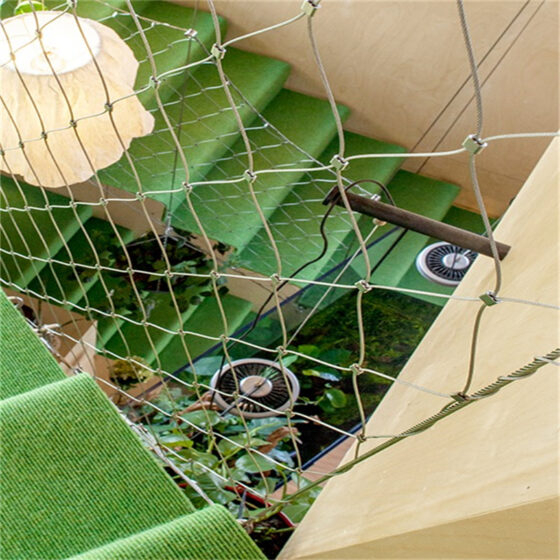
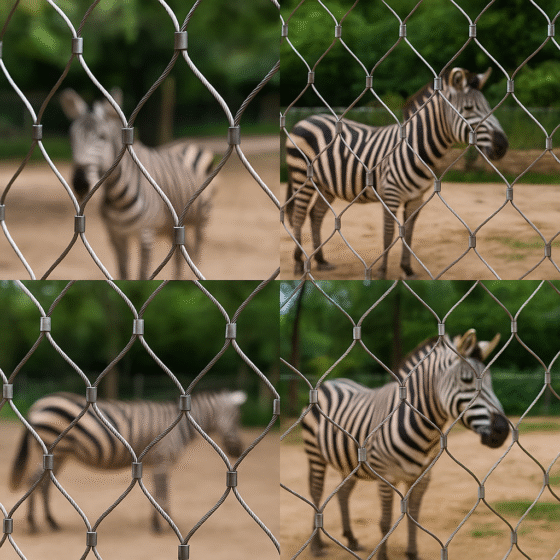
 TIF-03: Ferrules rope mesh tiger fencing has attractive appearance. | 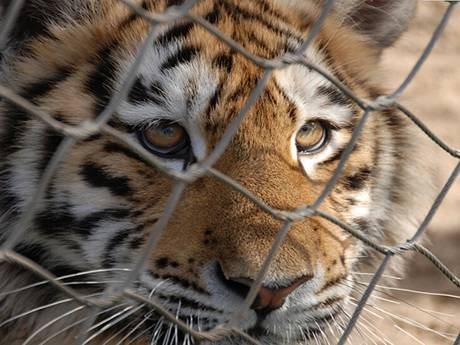 TIF-04: Hand woven tire rope mesh tiger fencing has no sharps. |
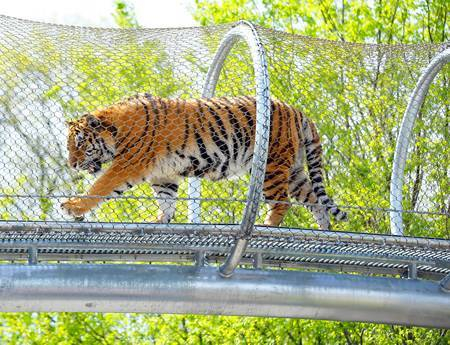 TIF-05: Stainless steel wire rope mesh can made into tiger passageway. | 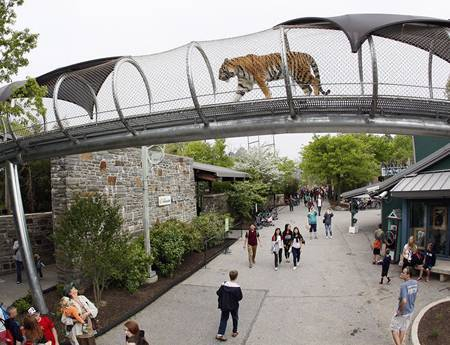 TIF-06: Rope mesh tiger passageway gives tiger a activity space and tourists a good sight. |
Specifications of Rope Mesh Tiger Fencing
- Materials: stainless steel 304, 304L, 316, 316L.
- Wire diameter: 2.38–3.2 mm.
- Hole sizes: 50–102 mm (distance between adjacent mesh knots).
- Panel size: enclosure length and height can be custom-made.
Specifications Rope mesh tiger fencing
| No. | MESH APERTURE (mm) | WIRE ROPE DIAMETER (mm) | MATERIALS | OPEN DEGREE OF TIGER ROPE MESH |
|---|---|---|---|---|
| 1 | 51 × 51 | 3.2 | AISI 316, 7×19 stainless steel wire rope | Low openness, ~55% open area – for high-impact lower wall zones |
| 2 | 60 × 60 | 3.2 | AISI 316, 7×19 stainless steel wire rope | Medium openness, ~68% – standard tiger wall mesh |
| 3 | 76 × 76 | 3.2 | AISI 316, 7×7 stainless steel wire rope | High openness, ~78% – upper wall and roof mesh |
| 4 | 51 × 51 | 3.0 | AISI 304, 7×7 stainless steel wire rope | Low openness, ~57% – dense mesh for training windows |
| 5 | 60 × 60 | 3.0 | AISI 304, 7×19 stainless steel wire rope | Medium openness, ~70% – general tiger enclosure mesh |
| 6 | 80 × 80 | 3.0 | AISI 316, 7×19 stainless steel wire rope | High openness, ~80% – roof panels and long spans |
| 7 | 51 × 51 | 2.7 | AISI 316L, 7×7 stainless steel wire rope | Medium-low openness, ~60% – lower band with lighter cable |
| 8 | 60 × 60 | 2.7 | AISI 316L, 7×19 stainless steel wire rope | Medium openness, ~72% – visual focus, lighter structure |
| 9 | 76 × 76 | 2.7 | AISI 304, 7×19 stainless steel wire rope | Very high openness, ~82% – low visual impact roof mesh |
| 10 | 51 × 51 | 2.4 | AISI 304, 7×7 stainless steel wire rope | Medium openness, ~62% – tiger tunnels with close viewing |
| 11 | 60 × 60 | 2.4 | AISI 304, 7×19 stainless steel wire rope | Medium-high openness, ~74% – overhead walkways |
| 12 | 80 × 80 | 2.4 | AISI 316, 7×7 stainless steel wire rope | Very high openness, ~84% – light roof over large habitats |
| 13 | 51 × 76 | 3.2 | AISI 316, 7×19 stainless steel wire rope | Medium-low openness, ~63% – reinforced corners and jump lines |
| 14 | 60 × 76 | 3.2 | AISI 316, 7×7 stainless steel wire rope | Medium openness, ~72% – mixed roof/wall transitions |
| 15 | 51 × 60 | 3.2 | AISI 304, 7×19 stainless steel wire rope | Low openness, ~58% – bottom 1.5 m anti-reach band |
| 16 | 51 × 51 | 3.8 | AISI 316, 7×19 stainless steel wire rope | Low openness, ~52% – extra heavy mesh for aggressive males |
| 17 | 60 × 60 | 3.8 | AISI 316, 7×19 stainless steel wire rope | Medium openness, ~66% – high-security perimeter tiger mesh |
| 18 | 76 × 76 | 3.8 | AISI 316, 7×19 stainless steel wire rope | High openness, ~76% – long-span roof with high load reserve |
| 19 | 51 × 64 | 3.0 | AISI 316L, 7×7 stainless steel wire rope | Medium-low openness, ~61% – tiger–keeper training walls |
| 20 | 64 × 64 | 3.0 | AISI 316L, 7×19 stainless steel wire rope | Medium-high openness, ~73% – main viewing faces |
| 21 | 70 × 70 | 3.0 | AISI 304L, 7×19 stainless steel wire rope | High openness, ~79% – upper wall where impact is lower |
| 22 | 55 × 80 | 3.2 | AISI 304L, 7×7 stainless steel wire rope | Medium openness, ~69% – sloped lean-in mesh above walls |
| 23 | 60 × 90 | 3.2 | AISI 316, 7×19 stainless steel wire rope | High openness, ~81% – airy roof over rockwork and trees |
| 24 | 70 × 100 | 3.2 | AISI 316, 7×7 stainless steel wire rope | Very high openness, ~86% – visual “disappearing” mesh for tall spans |
Rope Mesh Tiger Fencing Features
- Highly durable and flexible: stainless steel rope structure absorbs impacts and will not break or deform easily.
- Maintenance-free: no need for regular painting or corrosion protection; only routine inspection is required.
- Beautiful and transparent: slim cables and diamond openings provide clear viewing and an open, modern appearance.
- Animal-friendly: smooth surfaces with no sharp points help protect the tiger’s fur and skin.
Rope Mesh Tiger Fencing Applications
- Provide tigers with a free activity space while ensuring visitor safety.
- Form overhead walkways and tunnels for tiger stretching and exercise.
- Used in outdoor habitats, holding yards, raceways and training walls.
Tiger Wire Rope Mesh – Popular FAQs
Q1. What material is best for tiger enclosure mesh?
A1. Most tiger enclosures use stainless steel wire rope mesh in grade 304 or 316.
304 is common for normal climates.
316 is preferred in coastal, humid or highly corrosive environments because of better corrosion resistance.
Q2. What wire rope diameter is recommended for tigers?
A2. For big cats such as tigers, leopards and lions, commonly used diameters are:
2.4 mm or
3.2 mm stainless steel cable
The exact choice depends on span length and impact level: heavier use or longer spans usually choose 3.2 mm.
Q3. What Rope mesh tiger fencing aperture (opening size) is suitable for tiger fencing?
A3. For tiger walls and roofs, popular mesh apertures are:
51 × 51 mm (2″ × 2″)
60 × 60 mm
76 × 76 mm (3″ × 3″)
Smaller openings like 51 mm are often used in the lower zone, and 60–76 mm higher up or on roof sections.
Q4. How high should a tiger mesh fence be?
A4. Typical recommendations for tiger fencing are:
Wall height around 3.5–5 m
Often combined with a 1 m inward lean-in/overhang or a full mesh roof
Final height must follow local zoo standards and regulations.
Q5. Is stainless steel rope mesh really stronger than ordinary iron or chain mesh?
A5. Yes. Stainless zoo mesh is made from 7×7 or 7×19 wire rope, which gives:
High tensile strength
Elasticity, so it can deform and recover under impact
Much better fatigue and corrosion resistance than ordinary iron mesh
It’s specifically designed for big cats and other strong animals.
Q6. How long does stainless steel tiger mesh last?
A6. In normal zoo conditions, stainless steel rope mesh is often designed for a service life of 20–30 years or more, with:
No need for repainting
Only routine inspection and simple cleaning
This makes it more economical long-term than many galvanized meshes.
Q7. Can rope mesh be used for overhead tiger tunnels and walkways?
A7. Yes. Rope mesh is widely used to build:
Overhead tiger tunnels
Aerial walkways and bridges
Because it is light, flexible and strong, it can be wrapped around steel rings or frames to form secure tubes that give tigers extra exercise space and visitors exciting overhead views.
Q8. Is the mesh safe for tiger paws, fur and skin?
A8. Stainless steel rope mesh is designed with:
Smooth cables
Rounded ferrules or knotted types rope mesh intersections
There are no sharp burrs, which helps prevent:
Fur damage
Cuts and abrasions
Snagged claws
Even when tigers climb, rub or jump against the mesh.
Q9. Does the Rope mesh tiger fencing block the view for visitors?
A9. No. One of the main reasons zoos choose rope mesh is its high transparency:
Thin stainless cables
Open diamond pattern
Together, they make the barrier appear very light, so visitors focus on the tiger and habitat, not on the fence.
Q10. Can I customise Rope mesh tiger fencing size, mesh shape and opening?
A10. Yes. Tiger rope mesh panels are usually fully customisable:
Panel length and height
Wire diameter
Mesh aperture (opening size)
Ferrule type or hand-woven style
Suppliers usually match a mesh code to your animal type, enclosure layout and safety requirements.
Q11. How is Rope mesh tiger fencing installed?
A11. Typical installation method:
Mesh is tensioned between steel posts, frames or beams
Border cables (4–6 mm) run around the panel perimeter
Mesh is fixed using clamps, lacing wire or special clips
For roofs and tunnels, the mesh is pulled tight over hoops or frames to prevent sagging or gaps.
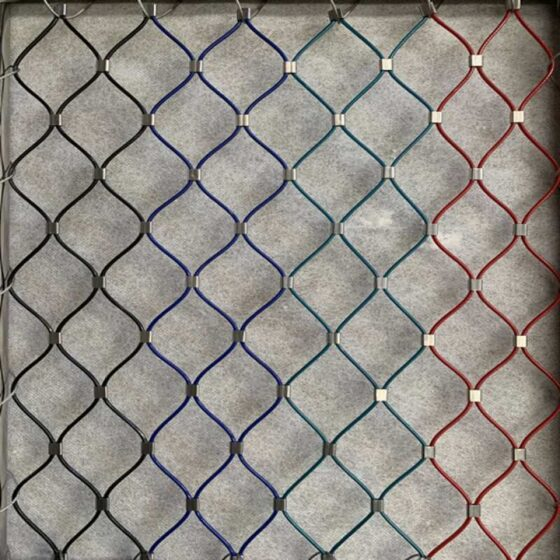
Q12. Is black-coated or coloured mesh available, and will it peel?
A12. Some manufacturers offer:
Black or coloured finishes on stainless rope mesh
These are usually bonded treatments rather than thick paint, so they’re designed not to chip or peel easily. For very high-wear tiger areas, many zoos still choose natural stainless finish for maximum durability.
Q13. What information do I need to get a quote?
A13. To get an accurate quotation for tiger rope mesh, you usually need:
Animal species (tiger only or mixed big cats)
Enclosure dimensions or drawings
Preferred wire diameter and mesh opening, if you already have a design
Required quantity and any special shapes (roof, tunnel, lean-in panels)
Destination country/port and whether you need samples