Your One-Stop Wire Mesh Fence Supplier | POLYMETAL
Stainless steel wire rope mesh
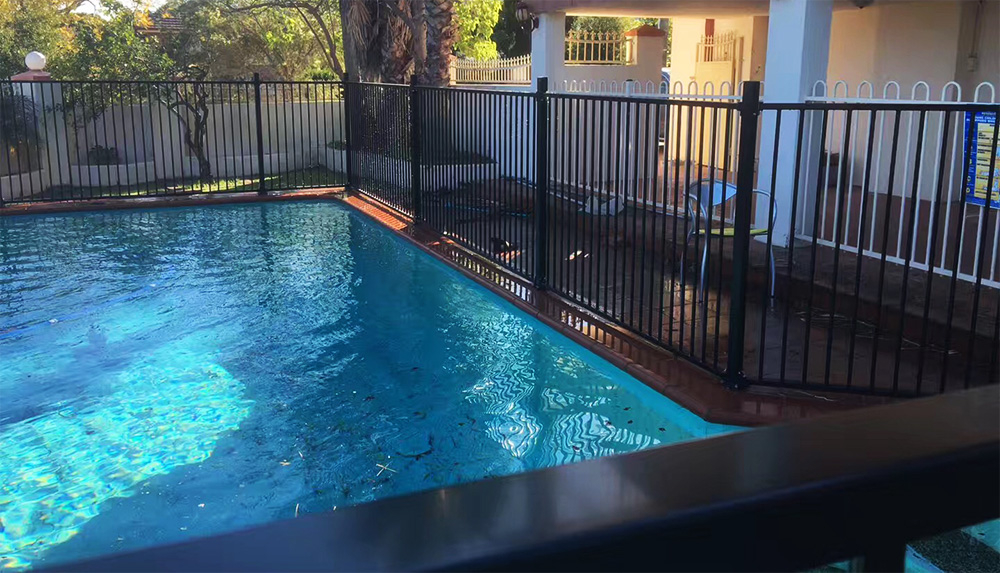
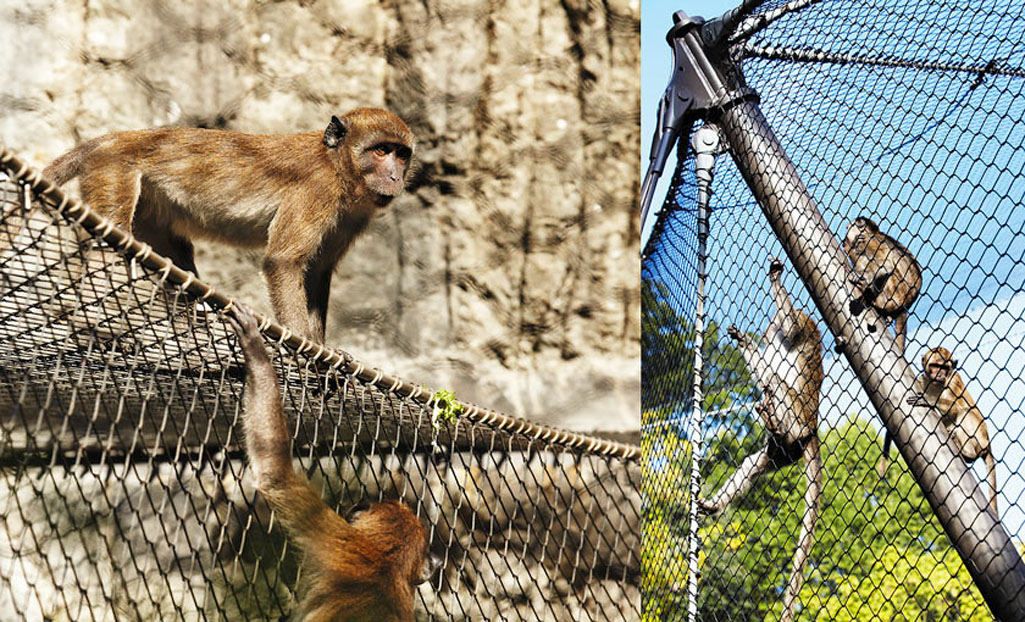
Stainless steel wire rope mesh is a hand-woven (or ferruled) stainless-cable net in a diamond pattern. It combines strength, flexibility, transparency, and durability, making it ideal for zoo aviaries, animal enclosures, balustrades, green façades, and public-safety barriers. For the case below—300 m² for an Australian zoo aviary—the recommended configuration is AISI 316L, 7×7 cable construction, Ø1.4–1.5 mm cable, and ~20 × 34.6 mm aperture, supplied in long panels for clean sightlines and faster installation. Where installations are adjacent to water features or public swim areas, the mesh can be detailed to meet the local pool fencing rules, ensuring safety compliance without sacrificing visibility.

Case Overview
Customer: Manager of a zoo in Australia
Use: Aviary (mixed species)
Key needs: Strong but gentle mesh with no sharp edges; excellent visibility and airflow; long service life outdoors; minimal maintenance
Quantity: 300 m²
Decision: Hand-woven stainless steel wire rope mesh (no welds, smooth nodes).
What Stainless Steel Wire Rope Mesh Is
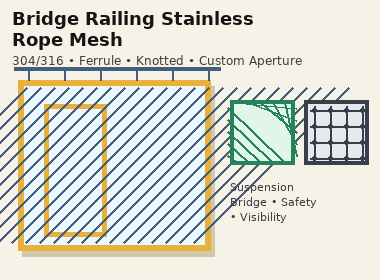
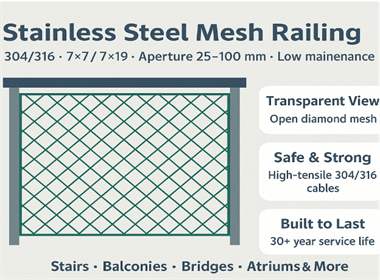
A flexible architectural net made from twisted stainless cables (commonly 7×7 or 7×19). The mesh forms a rhomboid (diamond) geometry that:
Spreads impact loads and recovers shape after deflection
Has no welds or hard crosspoints that could create burrs
Delivers high transparency with low visual bulk
Two common styles
Interwoven (sleeveless/hand-woven): Cables pass through one another; smooth, minimal nodes; premium transparency.
Ferruled (sleeved): Intersections pressed with ferrules; fast to assemble and economical for certain sizes.
Why It’s Ideal for Aviaries
Animal safety: Smooth, flexible contact; no sharp welds; reduces feather abrasion and impact injury.
Visibility: High light transmission; “nearly invisible” from a distance for a natural viewing experience.
Durability: 316/316L resists rain, UV, and coastal salt spray; decades-long service with low maintenance.
Adaptability: Conforms to curves, cones, domes, and tension rings; suits frameless/minimal-frame designs.
Sustainability: Long lifespan; fully recyclable metal.
Application & Sizing Shortlist
Small birds / mixed aviaries: Ø1.2–1.5 mm cable; ~20 × 35 mm aperture
Medium birds / sensitive species: Ø1.5–1.8 mm; ~25 × 44 mm
Large birds / raptors / primates: Ø1.8–2.0 mm; ~30 × 52 mm (or stronger)
Engineering & Detailing Essentials
Load path: Mesh → edge lacing/cables → anchors → primary frame.
Tension & mesh angle: Set the diamond to ~60° for uniform load sharing and crisp appearance.
Corners & edges: Reinforce corners; specify proper edge types; keep cut ends hidden in the edge termination.
Thermal movement: Provide take-up (turnbuckles) for temperature expansion/contraction.
Corrosion control: Prefer all-stainless hardware; isolate from carbon steel/galvanized parts if mixed.
Fire & egress: Non-combustible; verify it doesn’t obstruct required exits or fire access.

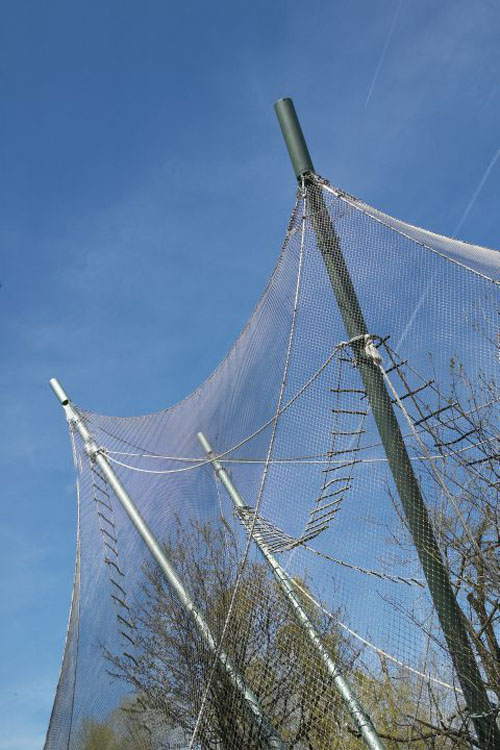
Installation Best Practices (7 Steps)
Survey & shop drawings: Confirm as-built dimensions and special shapes before fabrication.
Trial hang at corners: Check panel ID, orientation (H/V), and fit.
Progressive tensioning: Work evenly along edges to approach ~60° mesh angle—avoid localized over-tension.
Perimeter lacing: Use matching stainless binding rope; plan ~3× total panel perimeter for lacing length.
Contact protection: Keep the mesh off sharp edges; add caps/liners where unavoidable.
Hidden terminations: No exposed cut ends; tighten and secure all hardware.
Final QA: Confirm door clearances, net rebound, snag-free edges, and label retention.
Cleaning, Maintenance & Lifecycle
Routine cleaning: Fresh-water rinse; neutral pH detergents for droppings/salt film.
Annual inspection: Corners, terminations, high-impact zones; re-tension if needed.
Repairs: Panels and ferrules (if used) can be replaced with basic press tools.
Service life: Decades in outdoor/coastal conditions with proper detailing and minimal upkeep.
Common Pitfalls (and Fixes)
Aperture too large for species → escape risk. Match aperture to the smallest species in the aviary.
Mixed metals → galvanic corrosion. Use stainless throughout or isolate dissimilar interfaces.
Uneven tension → wrinkles/poor rebound. Tension progressively; verify mesh angle across the surface.
Exposed cut ends → injury hazard. Avoid field cuts; if unavoidable, recess ends into edge terminations.
Insufficient stand-off → abrasion at hard edges. Add buffers or adjust bracketry.


Procurement & QA Checklist
Inside-frame panel dimensions (drawings preferred)
Cable diameter and aperture (approve a physical swatch)
Mesh orientation (H/V) and target angle (~60°)
Edge type and complete hardware schedule (all stainless)
Panel IDs and packing plan (rolled panels; wooden cases)
Certificates & manuals: 316/316L mill certs, inspection records, installation/maintenance guide
Complete Specifications (English Table, No Links)
A. Project Summary
| Item | Specification |
|---|---|
| Project | Australian zoo aviary enclosure |
| Customer | Zoo facility manager (Australia) |
| Quantity | 300 m² total |
| Product | Stainless Steel Wire Rope Mesh |
| Manufacturing | Hand-woven (interwoven, sleeveless) — no welds, no sharp burrs |
| Animal focus | Small–medium birds, mixed species |
| Environment | Outdoor; UV, rain, and coastal salt-spray resistant |
B. Materials & Construction
| Item | Specification |
|---|---|
| Stainless grade | AISI 316L (marine grade corrosion resistance) |
| Cable construction | 7×7 standard (7×19 optional for extra flexibility) |
| Cable diameter | Ø1.4 mm (project request). Option: Ø1.5 mm for added durability/impact |
| Mesh geometry | Diamond (rhomboid) |
| Aperture | 20 mm × 34.6 mm (short way × long way) |
| Installed mesh angle | Target ~60° |
| Orientation | H or V to suit framing/drainage |
| Surface | Uncoated stainless, mill finish |
| Edge termination | Standard H24 / V24 edge types for clean, strong perimeters |
| Node style | Interwoven nodes (no ferrules). Ferruled option available on request |
C. Mechanical & Safety (General)
| Item | Specification |
|---|---|
| Structural behavior | Flexible, elastic recovery after load; no brittle fracture points |
| Contact safety | Smooth nodes, no welds or spatter; gentle to feathers and skin |
| Escape prevention | 20 × 34.6 mm opening suited to small birds; high airflow and visibility |
| Transparency | High light transmission; near-invisible beyond a few meters |
| Fire behavior | Non-combustible metal mesh |
| Environmental durability | Excellent weatherability; minimal maintenance |
D. Panelization & Dimensions
| Item | Specification |
|---|---|
| Example panel size | 30 m (L) × 4 m (H) long panels to reduce seams (custom shapes by drawing) |
| Panelization approach | Split by doorways, corners, and maintenance corridors; minimize field cutting |
| Total area | 300 m² (final take-off per construction drawings) |
E. Stainless Steel Wire Rope Mesh Accessories & Hardware
| Item | Specification |
|---|---|
| Binding rope | Stainless 316L Ø1.5–2.0 mm; recommend ≈ 3 × total panel perimeter |
| Tension/fixings | Stainless 316/316L turnbuckles, thimbles, shackles, clamps, clips as detailed |
| Frames/rails | Stainless 316/316L or galvanized steel with stainless interface isolation as needed |
F.Stainless Steel Wire Rope Mesh Installation Notes
| Item | Specification |
|---|---|
| Survey & templating | Verify field dimensions; pre-shape complex curves at factory where feasible |
| Hang & tension | Fix corners first; tension evenly to ~60° mesh angle |
| Lacing | Continuous perimeter lacing with stainless binding rope; use temporary ties for set-out |
| Stand-off & guards | Maintain clearance from hard edges; add caps/liners at contact points |
| Edge safety | Hide all cut ends inside edge terminations; no exposed wire tails |
G. Maintenance & Cleaning
| Item | Specification |
|---|---|
| Routine | Fresh-water rinse; neutral pH detergent for droppings/salt film |
| Annual check | Inspect corners, lacing, anchors, and high-impact zones; re-tension as needed |
| Service life | Long outdoor life with 316/316L; very low maintenance burden |
H. Packaging & Logistics
| Item | Specification |
|---|---|
| Supply form | Rolled panels for easy handling and deployment |
| External packing | Wooden cases; each roll/panel labeled with ID, size, and orientation |
| Labeling | Panel ID, spec, dimensions, quantity, and install direction per piece |
I. Quantity & Example Take-Off (for site planning)
| Item | Detail |
|---|---|
| Example panel set | Two panels 30 m × 4 m (each 120 m²) + one panel 15 m × 4 m (60 m²) = 300 m² |
| Binding rope estimate | Perimeter of a 30 × 4 m panel = 2 × (30 + 4) = 68 m. Two such panels = 136 m. One 15 × 4 m panel perimeter = 2 × (15 + 4) = 38 m. Total perimeter = 174 m. Recommended binding rope ≈ 3 × 174 m = 522 m (plus contingency). |
J. Submittals (with shipment or upon request)
| Item | Specification |
|---|---|
| Mill certificates | Grade and heat numbers for 316/316L cables and hardware |
| Shop drawings | Panel IDs, dimensions, edge types, hardware schedule |
| Installation manual | Tensioning targets, sequence, and maintenance guidance |
Quick Spec Stainless Steel Wire Rope Mesh
Product: Stainless Steel Wire Rope Mesh, hand-woven (interwoven)
Grade: AISI 316L stainless steel
Cable: 7×7, Ø1.4 mm (option Ø1.5 mm)
Aperture: 20 × 34.6 mm diamond, installed at ~60°
Orientation: H or V to suit framing
Edges: H24/V24 perimeter; no exposed cut ends
Hardware: All stainless (316/316L) turnbuckles, thimbles, shackles, clamps, binding rope
Panels: Long panels (e.g., 30 m × 4 m) with factory labels; total area 300 m²
Finish: Uncoated stainless, mill finish
Packaging: Rolled panels in wooden cases; panel IDs and orientation marked
Cleaning: Fresh-water rinse; neutral pH detergents as needed
Maintenance: Annual inspection and re-tension as required
Conclusion
For the Australian zoo’s 300 m² aviary, our hand-woven stainless steel wire rope mesh—commonly known as zoo mesh—delivers animal-safe softness, crisp transparency, and long-term durability in harsh outdoor conditions. The combination of 316L, Ø1.4–1.5 mm cable, and ~20 × 34.6 mm aperture provides secure containment for small and medium birds while maintaining a bright, open habitat and low lifetime cost. For budgeting, zoo mesh cost typically ranges around US$20–40 per m², putting 300 m² at roughly US$6,000–12,000 for mesh only; hardware, shipping, taxes, and installation are additional. Finer apertures, heavier cables, or complex shapes can increase zoo mesh cost, while bulk orders and efficient panelization can reduce the overall zoo mesh cost.