 Your One-Stop Wire Mesh Fence Supplier | POLYMETAL
Plain Weave Stainless Steel Wire Cloth
In today’s industrial world, filtration, separation, screening, protection, and architectural applications demand materials that combine precision, durability, and corrosion resistance.
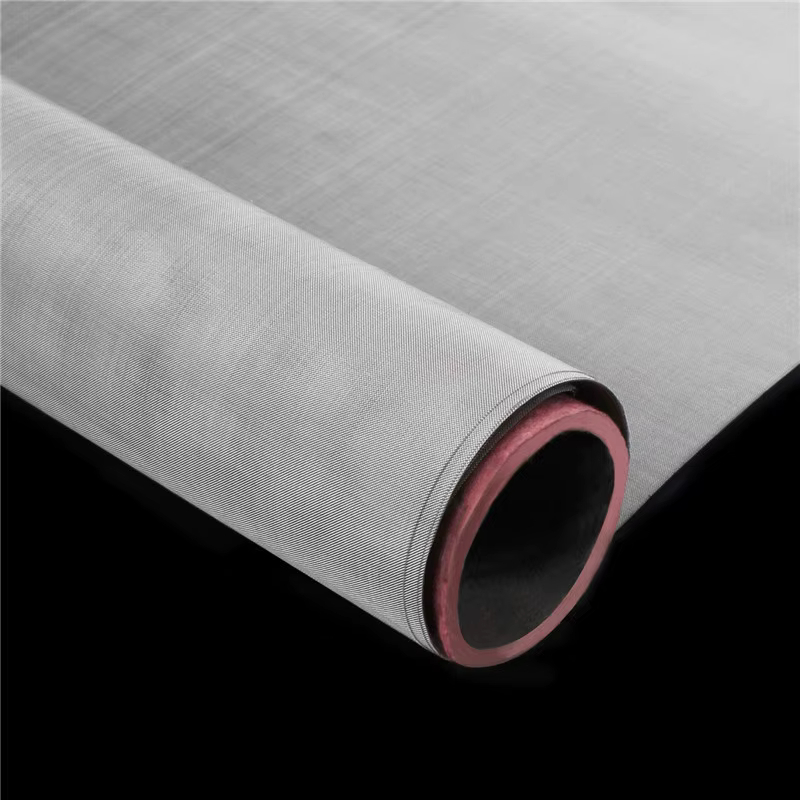
Among the most reliable and widely used options is the Plain Weave Stainless Steel Wire Cloth—a fabric meticulously woven using stainless steel wires in an over-under pattern.
This structure provides uniform openings, mechanical stability, excellent chemical resistance, and a wide range of specifications suitable for fine or coarse filtration tasks.
From aerospace to food processing, this mesh plays an indispensable role in ensuring purity, precision, and performance.
2. Material Composition
Plain weave stainless steel wire cloth is primarily made from:
AISI 304 / 304L — The most common stainless steel; excellent corrosion resistance for general applications.
AISI 316 / 316L — Superior resistance to acid, alkali, and chlorides; ideal for marine and chemical environments.
Optional materials include 321, 310, 430, duplex stainless steels, and Inconel alloys, depending on service conditions.
Each grade is selected based on corrosion environment, temperature range, and mechanical requirements.

3. Weaving & Structural Features Plain Weave Stainless Steel Wire Cloth
| Property | Description |
|---|---|
| Weave Style | Plain weave (warp and weft wires cross alternately over and under). |
| Structure | Compact, uniform, square openings. |
| Technique | Precision woven using advanced looms ensuring consistent aperture size. |
| Surface | Smooth, bright, free of oil or defects after annealing and cleaning. |
Key Features
High weaving precision and structural uniformity
Excellent acid and alkali resistance
High filtration precision and wear resistance
Strong compression and tensile performance
Stable under high pressure and temperature
Not easy to deform, even under vibration or load
4. Technical Specifications
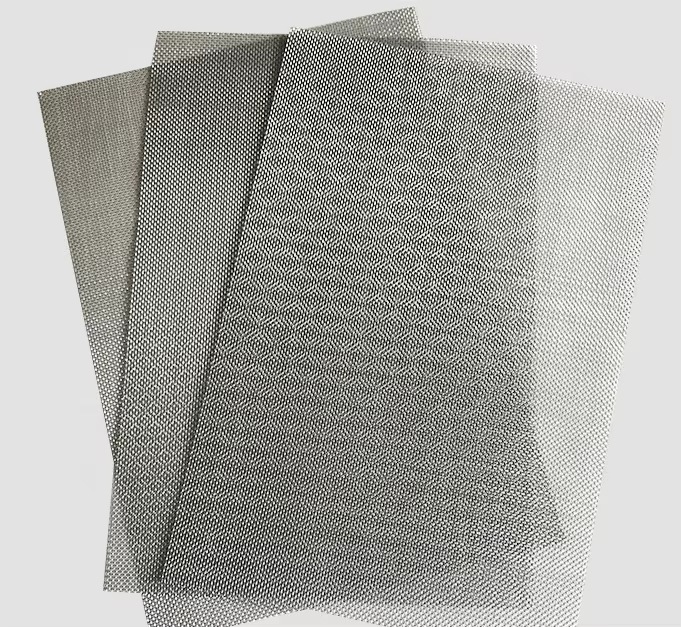
Description Stainless Steel Plain Wire Cloth
Mesh Range: 1×1 to 635×635 mesh/inch
Wire Diameter Range: 0.008–0.08 inch (0.020–2.03 mm)
Opening Size Range: 0.0008–0.92 inch (0.020–23.37 mm)
Hole Style: Square
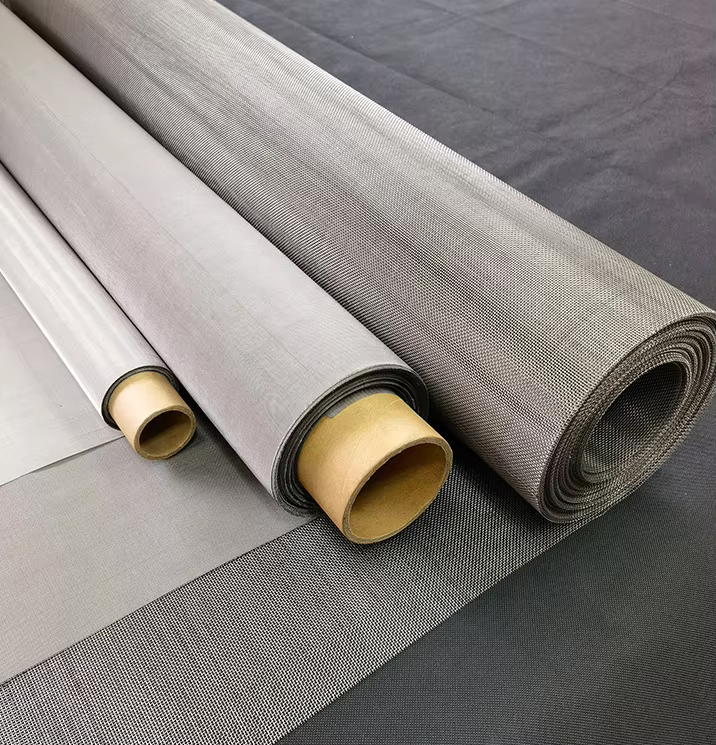
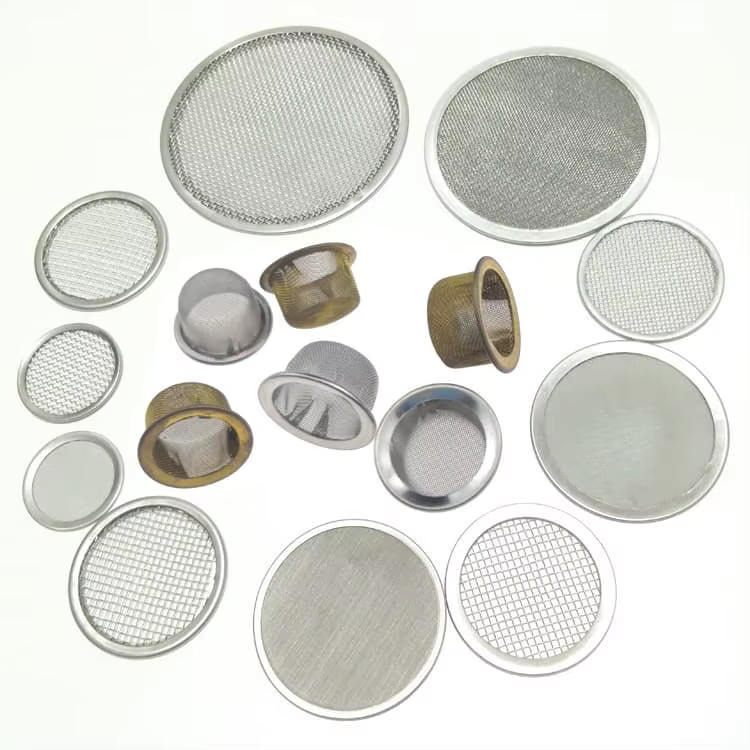
Form Available: Rolls, sheets, cut panels, discs, sintered filters.
| Mesh/Inch | Wire Diameter | Aperture | Open Area | Weight(LB)/100 Square Foot | ||
| Inch | MM | Inch | MM | |||
| 1×1 | .080 | 2.03 | .920 | 23.37 | 84.6 | 41.1 |
| 2X2 | .063 | 1.60 | .437 | 11.10 | 76.4 | 51.2 |
| 3X3 | .054 | 1.37 | .279 | 7.09 | 70.1 | 56.7 |
| 4X4 | .063 | 1.60 | .187 | 4.75 | 56.0 | 104.8 |
| 4X4 | .047 | 1.19 | .203 | 5.16 | 65.9 | 57.6 |
| 5X5 | .041 | 1.04 | .159 | 4.04 | 63.2 | 54.9 |
| 6X6 | .035 | .89 | .132 | 3.35 | 62.7 | 48.1 |
| 8X8 | .028 | .71 | .097 | 2.46 | 60.2 | 41.1 |
| 10X10 | .025 | .64 | .075 | 1.91 | 56.3 | 41.2 |
| 10X10 | .020 | .51 | .080 | 2.03 | 64.0 | 26.1 |
| 12X12 | .023 | .584 | .060 | 1.52 | 51.8 | 42.2 |
| 12X12 | .020 | .508 | .063 | 1.60 | 57.2 | 31.6 |
| 14X14 | .023 | .584 | .048 | 1.22 | 45.2 | 49.8 |
| 14X14 | .020 | .508 | .051 | 1.30 | 51.0 | 37.2 |
| 16X16 | .018 | .457 | .0445 | 1.13 | 50.7 | 34.5 |
| 18X18 | .017 | .432 | .0386 | .98 | 48.3 | 34.8 |
| 20X20 | .020 | .508 | .0300 | .76 | 36.0 | 55.2 |
| 20X20 | .016 | .406 | .0340 | .86 | 46.2 | 34.4 |
| 24X24 | .014 | .356 | .0277 | .70 | 44.2 | 31.8 |
| 30X30 | .013 | .330 | .0203 | .52 | 37.1 | 34.8 |
| 30X30 | .012 | .305 | .0213 | .54 | 40.8 | 29.4 |
| 30X30 | .009 | .229 | .0243 | .62 | 53.1 | 16.1 |
| 35X35 | .011 | .279 | .0176 | .45 | 37.9 | 29.0 |
| 40X40 | .010 | .254 | .0150 | .38 | 36.0 | 27.6 |
| 50X50 | .009 | .229 | .0110 | .28 | 30.3 | 28.4 |
| 50X50 | .008 | .203 | .0120 | .31 | 36.0 | 22.1 |
| 60X60 | .0075 | .191 | .0092 | .23 | 30.5 | 23.7 |
| 60X60 | .007 | .178 | .0097 | .25 | 33.9 | 20.4 |
| 70X70 | .0065 | .165 | .0078 | .20 | 29.8 | 20.8 |
| 80X80 | .0065 | .165 | .0060 | .15 | 23.0 | 23.2 |
| 80X80 | .0055 | .140 | .0070 | .18 | 31.4 | 16.9 |
| 90X90 | .005 | .127 | .0061 | .16 | 30.1 | 15.8 |
| 100X100 | .0045 | .114 | .0055 | .14 | 30.3 | 14.2 |
| 100X100 | .004 | .102 | .0060 | .15 | 36.0 | 11.0 |
| 100X100 | .0035 | .089 | .0065 | .17 | 42.3 | 8.3 |
| 110X110 | .0040 | .1016 | .0051 | .1295 | 30.7 | 12.4 |
| 120X120 | .0037 | .0940 | .0064 | .1168 | 30.7 | 11.6 |
| 150X150 | .0026 | .0660 | .0041 | .1041 | 37.4 | 7.1 |
| 160X160 | .0025 | .0635 | .0038 | .0965 | 36.4 | 5.94 |
| 180X180 | .0023 | .0584 | .0033 | .0838 | 34.7 | 6.7 |
| 200X200 | .0021 | .0533 | .0029 | .0737 | 33.6 | 6.2 |
| 250X250 | .0016 | .0406 | .0024 | .0610 | 36.0 | 4.4 |
| 270X270 | .0016 | .0406 | .0021 | .0533 | 32.2 | 4.7 |
| 300X300 | .0051 | .0381 | .0018 | .0457 | 29.7 | 3.04 |
| 325X325 | .0014 | .0356 | .0017 | .0432 | 30.0 | 4.40 |
| 400X400 | .0010 | .0254 | .0015 | .370 | 36.0 | 3.3 |
| 500X500 | .0010 | .0254 | .0010 | .0254 | 25.0 | 3.8 |
| 635X635 | .0008 | .0203 | .0008 | .0203 | 25.0 | 2.63 |
5. Applications Plain Weave Stainless Steel Wire Cloth
Plain weave stainless steel wire cloth serves across industries for diverse mechanical and filtration needs.
Industrial Uses
Liquid & Gas Filtration: Water, oil, chemical, and fuel precision pressure filters.
Vacuum Filtration Systems: In laboratories, aerospace and semiconductor processing.
Petroleum & Chemical Processing: Catalyst support, refining screens, and protection meshes.
Rubber and Tire Manufacturing: Screens for compounding and extrusion.
Metallurgy & Mining: Separation and sizing of ores and powders.
Pharmaceutical & Food Processing: Hygienic sieving, drying trays, and fluidized beds.
Architectural & Decorative Uses
Façade cladding, partitions, ceilings, and fireplace screens where design aesthetics combine with strength and corrosion resistance.
Other Functional Areas
Electromagnetic shielding (EMI/RFI)
Heat treatment baskets and trays
Protective barriers for machinery and ventilation openings.
6. Benefits
| Category | Benefits |
|---|---|
| Mechanical | High tensile strength, compression resistance, and dimensional stability. |
| Corrosion Resistance | Excellent performance against acids, alkalis, saltwater, and oxidation. |
| Thermal Resistance | Operates reliably at both sub-zero and elevated temperatures. |
| Precision Filtration | Uniform apertures for predictable particle retention. |
| Hygienic | Easy to clean, sterilize, and maintain; ideal for food and medical use. |
| Versatile Design | Broad mesh range enables both coarse screening and microfiltration. |
| Aesthetic Durability | Lustrous finish and architectural adaptability. |
| Cost Efficiency | Long service life offsets higher initial investment. |
7. Packaging and Handling Plain Weave Stainless Steel Wire Cloth
Proper packaging ensures that wire cloth reaches the customer undamaged and contamination-free:
Standard Rolls: Wound on paper or steel cores, wrapped in moisture-proof plastic film and kraft paper.
Protection: Bubble wrap or wooden boxes for overseas shipping.
Palletization: Rolls secured with steel straps and corner protectors.
Labelling: Each roll marked with mesh count, wire diameter, material grade, batch, and inspection seal.
Storage: Keep in a dry, clean environment, avoiding direct exposure to corrosive vapors or humidity.
8. Compliance & Standards
Plain weave stainless steel wire cloth is produced according to global specifications:
ASTM E2016-15 — Industrial woven wire cloth specification
ASTM A580/A580M — Stainless steel wire
ISO 9044:1999 — Technical requirements and testing for industrial woven wire cloth
ASTM E2814-11 — Industrial woven wire filter cloth guide
DIN 4185-1 / BS 481-1 / GB/T 5330-2003 — National standards for mesh production
Compliance ensures accuracy in wire diameter, mesh count, aperture size, open area, and material composition.
9. Quality Inspection
Each batch of wire cloth is tested for:
Wire diameter and aperture precision
Uniform mesh count per inch
Surface flatness, brightness, and absence of defects (broken wires, folds, rust spots)
Mechanical tensile test of woven fabric
Dimensional tolerances and flatness of rolls/sheets
Corrosion resistance verification (pickling/passivation test)
10. Maintenance and Cleaning Plain Weave Stainless Steel Wire Cloth
To extend service life:
Clean periodically using warm water and mild detergent or industrial ultrasonic cleaning.
Avoid exposure to strong chloride solutions unless using grade 316L.
Handle gently to prevent deformation or crease marks.
Inspect before reuse in filtration systems.
11. Advantages Over Other Materials
| Property | Plain Weave Stainless Steel | Brass / Copper Mesh | Nylon / Polyester Mesh |
|---|---|---|---|
| Corrosion Resistance | Excellent | Moderate | Poor in acids |
| Temperature Resistance | Up to 800 °C | Limited | < 150 °C |
| Strength | High | Medium | Low |
| Reusability | Excellent | Good | Limited |
| Hygiene | Excellent | Fair | Poor |
| Cost (Lifecycle) | Economical over time | Moderate | Cheap but short life |
13. Frequently Asked Questions (FAQ)
Q1: What exactly is plain weave stainless steel wire cloth?
Plain weave wire cloth is a woven stainless-steel fabric in which each warp wire alternately passes over and under each weft wire, creating a grid of square openings. It’s the most basic and widely used weave, offering consistent structure, high strength, and uniform aperture size.
Q2: What materials or grades are commonly used?
The most common grades are 304, 304L, 316, and 316L stainless steel. These offer corrosion resistance, durability, and versatility.
For special environments, grades such as 310, 321, 430, duplex, or Inconel alloys may also be used depending on chemical and temperature exposure.
Q3: How are Plain Weave Stainless Steel Wire Cloth size, wire diameter, and aperture defined?
Mesh count: Number of openings per linear inch.
Wire diameter: The thickness of each wire.
Aperture (opening size): The space between two parallel wires.
These three factors determine the open area and the performance of the wire cloth. Smaller apertures mean finer filtration but lower flow rate.
Q4: Why choose plain weave over other weaves?
Plain weave offers a balanced combination of precision, strength, and economy. It has uniform openings, easy cleanability, and wide availability.
Twill and Dutch weaves are better for very fine filtration, but plain weave is ideal for most general applications due to its simplicity and versatility.
Q5: What are the main applications of plain weave stainless steel wire cloth?
It is widely used in:
Filtration systems for liquids and gases
Vacuum and pressure filters
Chemical and petroleum industries
Food and pharmaceutical processing
Mining and metallurgy for sieving and screening
Aerospace and automotive fuel or hydraulic filters
Architectural and decorative panels, ceilings, and partitions
Q6: What are the main benefits of using stainless steel plain weave mesh?
Excellent corrosion and heat resistance
High mechanical strength and dimensional stability
Uniform filtration precision
Ease of cleaning and reusability
Hygienic and non-reactive surface for sensitive industries
Aesthetic appearance for architectural uses
Long service life and cost-effectiveness
Q7: What standards govern plain weave stainless steel wire cloth?
International standards include:
ASTM E2016 – Industrial woven wire cloth specification
ASTM A580 – Stainless steel wire material standard
ISO 9044 – Industrial woven wire cloth technical requirements
DIN 4185 / BS 481 / GB/T 5330 – Regional equivalents
Compliance ensures consistency in mesh count, aperture, wire diameter, and quality.
Q8: How is stainless steel wire cloth packaged and shipped?
Rolls are wound on cores and wrapped in moisture-proof plastic and kraft paper.
For export, rolls are palletized or boxed for protection.
Each roll is labeled with mesh count, wire diameter, grade, and lot number.
Storage should be in a dry, clean, and ventilated area to prevent corrosion.
Q9: What are common defects or issues to inspect for?
Typical defects may include:
Folding marks or creases
Broken wires or holes
Rust spots or discoloration
Uneven apertures or distorted weave
Loose or twisted wires
Each roll should be visually inspected and measured before use to ensure conformity.
Q10: How do I select the right mesh for my application?
Consider these factors:
Particle size or filtration precision required
Fluid flow rate and desired open area
Chemical and temperature conditions
Mechanical strength needs
Budget vs. longevity balance
For high corrosion or temperature applications, select 316/316L stainless steel with appropriate mesh count.
Q11: What is the relationship between mesh count and aperture size?
The relationship is inverse:
Higher mesh count → smaller openings
Lower mesh count → larger openings
Selecting mesh depends on the size of particles to be filtered and desired flow rate.
Q12: Can plain weave stainless steel mesh be used outdoors or in corrosive environments?
Yes. When made from 316 or 316L stainless steel, it performs exceptionally well in marine, coastal, and industrial atmospheres. It resists corrosion from saltwater, humidity, and many chemicals.
Q13: How is quality tested in production?
Quality inspection includes:
Checking wire diameter, mesh count, and aperture size
Flatness and surface finish evaluation
Mechanical strength testing
Corrosion resistance checks
Final inspection for uniformity and defects
Certified quality control ensures the mesh meets ASTM and ISO standards.
Q14: Can the Plain Weave Stainless Steel Wire Cloth be cleaned and reused?
Yes. Stainless steel mesh can be cleaned and reused many times using warm water, mild detergent, or ultrasonic cleaning systems. After cleaning, ensure no deformation or blocked openings remain before reinstallation.
Q15: What determines the cost of stainless steel wire cloth?
Cost depends on:
Stainless steel grade (316 > 304)
Mesh count and wire thickness
Roll width, length, and order quantity
Additional finishing (annealing, cutting, passivation)
Packaging and transportation costs
Bulk orders and standard sizes are generally more economical.
Q16: How should the mesh be stored and handled?
Store in dry, indoor areas, away from chemicals and moisture.
Keep rolls upright or flat to prevent edge damage.
Avoid dragging the mesh to prevent scratches.
Handle with gloves to maintain cleanliness and prevent fingerprints or oil stains.
Q17: Are there any limitations to using plain weave mesh?
Yes, some limitations include:
Not suitable for ultra-fine filtration (use Dutch or twill weave instead).
Flow rate reduction in very fine meshes.
Deformation risk if overloaded or bent sharply.
Must be properly matched to corrosion and temperature conditions.
Q18: Can stainless steel mesh be customized?
Absolutely. Manufacturers offer:
Custom roll widths and lengths
Cut-to-size panels and discs
Framed filters and screens
Welded edges or reinforced borders
Custom designs can be tailored for filtration systems, sieves, or decorative installations.
Q19: What affects the service life of the mesh?
Key factors include:
Proper grade selection for environment
Correct installation tension and framing
Regular cleaning and maintenance
Avoiding mechanical wear and corrosion buildup
When used correctly, stainless steel plain weave mesh can last many years with consistent performance.
Q20: What formats are available for purchase?
Plain weave stainless steel wire cloth is supplied as:
Standard rolls (30–100 ft)
Cut sheets and filter discs
Cylindrical or conical filter elements
Pre-framed panels for architectural or industrial use
Q21: What does “open area” mean?
Open area refers to the percentage of total mesh surface that is open space.
A higher open area allows greater flow but lower particle retention. Balancing open area and strength is crucial for effective filtration.
Q22: How does environment affect corrosion resistance?
Environments rich in chlorides, acids, or alkalis can accelerate corrosion. Selecting the correct stainless steel grade—typically 316L for marine or acidic conditions—ensures longer service life.
Q23: Can I order cut-to-size or fabricated mesh components?
Yes. Customers can specify exact dimensions, edge finish, and frame type.
When ordering, provide details such as material grade, mesh count, aperture size, and tolerance requirements.
Q24: How do I verify quality upon receiving a shipment?
Check mesh count and wire diameter with gauges
Inspect surface finish for defects
Verify material grade via certificate
Ensure packaging is intact and free from moisture damage
Any discrepancies should be reported immediately for replacement or adjustment.
Q25: What is the overall advantage of plain weave stainless steel wire cloth?
It provides an optimal balance of strength, corrosion resistance, uniformity, and versatility.
With proper selection and handling, it serves reliably in industrial filtration, construction, and architectural applications, combining technical performance with long-term durability.
13. Conclusion
Plain Weave Stainless Steel Wire Cloth combines engineering precision, strength, and corrosion resistance in one versatile product.
Its performance in filtration, separation, protection, and design applications makes it a key material for industries ranging from aerospace to pharmaceuticals — and even architectural systems such as ClearVu fencing, where visibility, security, and durability are essential.
With a specification range from 1×1 mesh to 635×635 mesh, stainless grades like 304 and 316, and compliance with ASTM and ISO standards, this material ensures reliability, repeatability, and long service life.