 Your One-Stop Wire Mesh Fence Supplier | POLYMETAL
Steel Fence Accessories: Dangerous Ultimate Top 10 Traps
Steel Fence Accessories are the parts that decide whether a fence line stays straight, tight, and secure after real-world pressure—wind, vibration, thermal movement, daily gate cycling, and years of weather exposure. Panels and posts get the attention, but accessories control the load path: where rails transfer force, how corners stay square, how gates self-close, and where corrosion starts (or gets stopped). This same “connection-first” rule is why many contractors also standardize compatible perimeter components such as standard temporary fencing for sale when they need fast, repeatable site setup without alignment surprises.
Top 10 High-Risk Traps for Steel Fence Accessories Orders
Steel Fence Accessories look small on a purchase order, but they control the entire fence system’s alignment, security, and service life. Each trap below can turn a “premium fence” into a rattling, loosening, rusting perimeter. Pay extra attention to #7—this is where many buyers take the biggest loss.
Trap #1: Buying “universal” brackets without locking the exact model and post condition
Line, corner, end, wall, and angle conditions load brackets differently. If you don’t lock the correct bracket model (for example, a line-post bracket vs a swivel bracket), rails get forced into position, holes elongate, and the fence line starts drifting under vibration.
Trap #2: Choosing fasteners by price instead of grade, head type, and coating
A cheap screw that strips, snaps, or corrodes will loosen first. Wrong head type also causes installer damage (cam-out), leaving partially tightened hardware that becomes the first rattle point on day one.
Trap #3: Mixing stainless, galvanized, and mild steel parts without thinking about corrosion coupling
When dissimilar metals are combined in wet or coastal conditions, corrosion can accelerate at contact points. The fence looks fine—until staining appears around bolts and brackets and the joint starts to seize.
Trap #4: Forgetting rail size and thickness when selecting bracket geometry
Brackets must match rail dimensions. If the bracket profile doesn’t seat properly, installers over-tighten to “force” fit, twisting the rail and creating permanent misalignment that becomes visible across long runs.
Trap #5: Underestimating corner and end loads—then rails “walk” over time
Corners and end posts take tension and torsion. If your accessory set is not designed for termination strength, rails slowly shift, gaps appear, and panels lose that straight architectural line that buyers pay for.
Trap #6: Treating hinge choice as “a gate detail” instead of a cycle-life decision
Gates are the highest-use component. If hinge capacity and adjustability do not match gate weight and daily openings, sag starts, latch alignment fails, and users begin forcing the gate—accelerating wear and damage.
Trap #7: Cutting corners on corrosion protection—then rust starts at screws, holes, and stressed joints
This is the biggest loss point. Most corrosion starts where accessories penetrate the finish: screw points, drilled holes, bracket edges, and hinge zones. Once rust begins, it spreads under coating, stains the fence, and turns “hardware” into replacement work across the whole line.
Trap #8: Ordering kits without locking the exact quantity per panel bay
If the kit count is wrong, installers improvise: fewer screws, missing bolts, swapped bracket models. That creates uneven loading and makes one bay loosen before the rest—starting a chain reaction of repairs.
Trap #9: Skipping torque discipline and using “impact-gun installation” with no control
Over-tightening strips threads and crushes bracket seats; under-tightening creates movement. Without a consistent tightening method, the fence becomes noisy and loose long before the panels themselves show any weakness.
Trap #10: Poor packing and mixed cartons—then parts arrive scratched, bent, or incomplete
Accessories are small, but packing mistakes are expensive. Mixed cartons cause site sorting delays, missing fasteners stop installs, and scratched coatings trigger early rust at contact points before the fence even goes up.
Why Steel Fence Accessories Matter More Than Buyers Expect
A fence system is not “strong” because the panel looks heavy. It is strong because the connections stay locked under repeated load. Brackets, bolts, screws, and hinges are the stress points that see movement first. When accessories are underspecified or mismatched, you get the classic failure pattern: rattling rails, loosened fasteners, twisting at corners, sagging gates, and corrosion bloom around penetrations—especially at high-cycle openings like garrison fencing gates.
Steel Fence Accessories Product Overview
- Made of high straight stainless steel with polyester powder coating.
- Supplied in kit form including all bolts and nuts to fasten horizontal rails to posts.
- Perfect to combine fence panels in lines or angles.
- High rust and corrosion resistance.
- Low maintenance.
- 20-year warranty of rust resistance
Core Steel Fence Accessories Categories
1) Steel Fence Brackets (Rail-to-Post Connection Control)
Brackets decide alignment, corner stability, and whether rails “walk” over time. The right bracket also simplifies installation by reducing on-site measuring errors and by keeping rail heights consistent across long runs.
2) Hinges for Steel Fence Gates (Cycle Life + Sag Control)
Gate hinges must survive repeated cycles without binding, wobble, or wear-driven sag. Self-closing hinges add convenience and reduce “gate left open” incidents, but only if the hinge load rating and post rigidity match the gate weight and daily duty cycle.
Steel Fence Brackets — Models & Technical Details
Quick Specification Table: Steel Fence Brackets
| Model | Type | Best Use | Fasteners Included | Typical Kit Rule |
|---|---|---|---|---|
| SFB-1 | Versatile bracket | Line / Corner / End post | #10 × 3/4″ screws, 1/4″ × 1-1/2″ carriage bolt, 1/4″ flange nut | Line/Corner: 2 brackets; End: 1 bracket |
| SFB-2 | Two-piece bracket | Line post | #14 × 3/4″ screws, 1/4″ × 1-1/2″ carriage bolt, 1/4″ flange nut | Line: 1 bracket (two-piece) per connection set |
| SFB-3 | Versatile bracket | Line / Corner / End post | #14 × 3/4″ screws, 1/4″ × 1-1/2″ carriage bolt, 1/4″ flange nut | Line/Corner: 2 brackets; End: 1 bracket |
| SFB-4 | Swivel bracket | Angles other than 90°; wall/timber/steel posts | #10 × 3/4″ screws | 2 screws are needed to fasten a bracket |
| SFB-5 | Multi-surface bracket | Line / Corner / End posts; wall/timber/columns | #10 × 3/4″ screws | 2 screws are needed to fasten a bracket |
Steel Fence Bracket Top-1
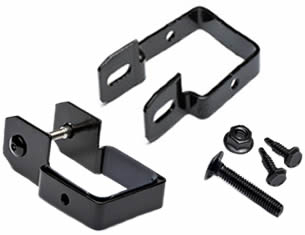
Versatile for fasten to the line, corner and end post.
Self- drilling screw: #10 × 3/4″.
Carriage bolt: 1/4″ × 1-1/2″.
Flange nut: 1/4″.
For line or corner: 2 brackets, 2 or 4 screws, 2 bolts and 2 nuts.
For end: 1 bracket, 1 or 2 screws, 1 bolt and 1 nut.
Steel Fence Bracket Top-2
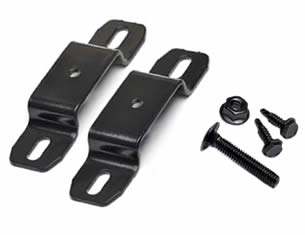
Two-piece bracket
Suitable for line posts.
Self-drilling screw: #14 × 3/4″.
Carriage bolt: 1/4″ × 1-1/2″.
Flange nut: 1/4″.
For line: 1 bracket, 2 screws, 2 bolts and 2 nuts.
Steel Fence Bracket Top-3

Versatile for fasten to a line, corner and end post.
Self- drilling screw: #14 × 3/4″.
Carriage bolt: 1/4″ × 1-1/2″.
Flange nut: 1/4″.
For line or corner: 2 brackets, 2 screws, 2 bolts and 2 nuts.
For end: 1 bracket, 1 screw, 1 bolt and 1 nut.
Steel Fence Bracket Top-4
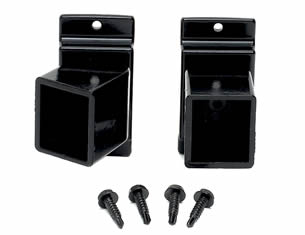
Swivel bracket for horizontal angles other than 90.
Suitable for being fixed to a wall, timber post, steel posts and columns.
Self-drilling screw: #10 × 3/4″.
2 screws are needed to fasten a bracket.
Steel Fence Bracket Top-5

Suitable for the line, corner or end posts.
Suitable for fixing to wall, timber or steel posts and columns.
Self-drilling screw: #10 × 3/4″.
2 screws are needed to fasten a bracket.
Hinges for Steel Fence Gates
Gate hinges are the “motion accessories” that decide whether your access point stays usable over time. The strongest gate leaf can still fail if hinge selection ignores load, duty cycle, and weather exposure.
Quick Specification Table: Gate Hinges
| Model | Material | Key Feature | Best For | Notes |
|---|---|---|---|---|
| SFH-1 | Reinforced polymer + internal stainless spring | Self-closing, tensile-adjustable | Mid-duty / heavy-duty steel fence gates | Rust-free body, smooth operation |
| SFH-2 | Stainless steel with polyester powder coating | Strongest structure (non self-closing) | Mid-duty / heavy-duty steel fence gates | High rust resistance, anti-weather |
Hinge SFH-1
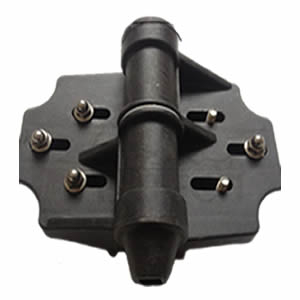
Self-closing,
Ideal for working with self-latching latch.
Made of high quality reinforced polymer.
Suitable for mid-duty or heavy-duty steel fence gate.
With internal stainless spring for self-closing.
Tensile-adjustable.
Rust-free through whole life and no-ragging.
Easy operation.
Hinge SFH-2
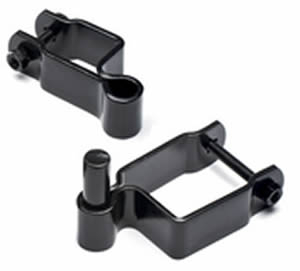
Made of high-quality stainless steel with polyester powder coating.
Suitable for mid-duty or heavy-duty steel fence gate.
Not capable of self-closing yet with the strongest structure.
High rust resistance was as well as anti-weather.
Easy operation.
Steel Fence Accessories Selection Guide
Line, Corner, End Post Rule
Use the correct bracket geometry for each post condition. Line posts need consistent rail height and fast installation. Corners need torsion control so the fence does not “open up” under load. End posts need locked termination so rails do not drift and loosen over time.
Angle Changes Beyond 90°
When the fence line changes direction at non-standard angles, swivel bracket solutions reduce field cutting, reduce rail distortion, and keep the fence line clean. That prevents awkward “forced alignment” that bends rails and weakens fastener seats.
Gate Duty Cycle Rule
If a gate is opened all day—schools, warehouses, staff access points—hinge selection must be based on cycle frequency. Self-closing hinges improve compliance and reduce “left open” events, but the post and hinge system must be rigid enough to prevent sag under repeated use.
Installation Checklist for Steel Fence Accessories
- Confirm post face alignment first; do not use brackets to “pull” a crooked post straight.
- Set bracket position consistently so rail heights remain uniform across the run.
- Use the correct screw size (#10 or #14) per bracket model to prevent stripping and loosening.
- Tighten bolts evenly to avoid twisting brackets and creating a permanent misalignment.
- For gates, confirm hinge spacing and latch alignment before final tightening.
- After the first operation cycle, re-check hardware torque to catch settling movement early.
Common Failure Points (What Goes Wrong First)
Bracket Loosening and Rail Rattle
This often starts when the wrong screw type is used, when rails are forced into alignment, or when fasteners are under-tightened. Once movement begins, holes elongate and loosening accelerates.
Gate Sag and Drag
Sag is usually a post rigidity problem that shows up at the hinge. If the post rotates slightly or if hinge selection does not match gate weight, the latch drops, the gate drags, and daily users start forcing operation—creating faster wear.
Corrosion at Penetrations
The first rust points are often where fasteners penetrate coated surfaces. Stainless and properly coated components reduce this risk, and clean installation prevents coating damage that exposes base metal.
Applications
- Steel garrison fencing lines (line/corner/end connections)
- Industrial and commercial perimeter fencing
- Schools and public-facing boundaries (tidy presentation + reliable gates)
- Warehouses, storage yards, and logistics sites (high cycle gates)
- Residential estates requiring strong fence structure and clean lines
Benefits
- Faster installation: kit-form accessories reduce missing parts and speed site assembly.
- Straighter fence lines: controlled bracket geometry prevents wave-lines and misalignment.
- Better corner stability: correct bracket selection protects direction changes under load.
- Improved gate reliability: correct hinge selection reduces sag and downtime.
- Corrosion resistance: stainless and coated components reduce early rust exposure.
- Lower maintenance: fewer adjustments, fewer call-backs, better long-term appearance.
Packing
POLYMETAL supplies Steel Fence Accessories in counted kits with labeled hardware packs to simplify receiving and reduce site confusion. Brackets are separated to prevent surface scratching, fasteners are packed by model and quantity, and cartons are labeled so installers can pick the correct kit for line posts, corners, ends, and gate hardware without re-sorting on site.
Standards and FAQs
Standards
Steel Fence Accessories are specified by function and environment: corrosion resistance level, hardware grade, bracket geometry, fastener type, and finish durability. For long service life, projects typically lock coating expectations, hardware material (stainless/polymer/steel), and installation rules for consistent alignment and torque.
FAQs
Q: Which bracket is best for line + corner + end posts?
A: SFB-1 and SFB-3 are versatile options designed for line, corner, and end conditions.
Q: Which bracket is best for angles other than 90°?
A: SFB-4 is a swivel bracket designed for horizontal angles beyond standard 90° corners.
Q: Which hinge is best if I want self-closing?
A: SFH-1 is self-closing and tensile-adjustable with an internal stainless spring.
Q: Which hinge is the strongest structure if I do not need self-closing?
A: SFH-2 is a stainless steel hinge with polyester powder coating and maximum structural strength.
Final Buying Reminder
If you want a fence line that stays straight and a gate that keeps cycling cleanly, do not treat accessories as “small parts.” Treat Steel Fence Accessories as the control system of your fencing: choose the right bracket model for line/corner/end conditions, lock the fastener set, and match hinge selection to gate weight and duty cycle. That is how you avoid loose rails, sagging gates, and early corrosion at the points that carry the most stress.