 Your One-Stop Wire Mesh Fence Supplier | POLYMETAL
Types of Steel Fence Gates: Dangerous 10 Ultimate Traps
When buyers search for types of steel fence gates, they are usually trying to solve one problem: how to control access without creating a weak point in the perimeter. A steel fence line can look strong, but the gate is the first place that gets tested—daily cycling, wind pressure, vehicle vibration, and leverage loads at hinges, rollers, posts, and latches. The safest gate choice is the one that matches your opening width, traffic frequency, site space, and long-term maintenance reality, especially when it must integrate cleanly with perimeter systems like standard temporary fencing for sale for fast site setup and repeatable boundary control.
Top 10 High-Risk Traps for Types of Steel Fence Gates
Choosing between the main types of steel fence gates (swing, sliding, cantilever, pedestrian, bi-fold) looks simple—until the wrong details create sagging, binding, and early rust. Pay special attention to #7, because that is where many buyers take the biggest loss.
Trap #1: Picking a swing gate when you don’t have real swing clearance
If vehicles, kerbs, slopes, or landscaping steal the swing arc, installers force the alignment, hinges get overloaded, and the gate starts dragging and twisting.
Trap #2: Choosing a sliding gate without enough “run-back” space
Sliding gates need travel length along the fence line. If you don’t have the run-back, the gate can’t fully open, or it hits posts/fence returns, creating constant impact damage.
Trap #3: Using a tracked sliding gate in debris-heavy ground with no cleaning plan
Tracks collect stones, mud, and leaves. Without drainage and routine clearing, rollers bind, wheels flat-spot, and the gate becomes heavy—then hardware fails early.
Trap #4: Choosing cantilever sliding without upgrading posts and foundations
Cantilever gates move the load into the support posts. If posts, brackets, and footings aren’t oversized, the system slowly rotates and the gate line drops.
Trap #5: Buying “no-sag” marketing instead of locking tube sizes and thickness
Two gates can look identical but use different gauge steel. Underspec’d frames flex, welds stress, and sag appears after repeated cycling even if day-one alignment was perfect.
Trap #6: Treating hinges and rollers as generic hardware
Hinges and rollers must match gate weight and daily cycles. Wrong hardware creates wobble, noise, and wear—and the gate starts to “fight” the user.
Trap #7: Cutting corners on corrosion protection—then rust starts at joints and penetrations
This is the biggest loss point for types of steel fence gates. Rust begins at welds, drilled holes, fasteners, hinge zones, and latch areas. Once corrosion spreads under coating, the gate becomes replacement work—fast.
Trap #8: Under-sizing gate posts and embedment depth
Gate performance is post performance. Shallow footings and thin posts allow rotation under leverage, causing sagging, latch misalignment, and dragging.
Trap #9: Ignoring wind load on wide/solid gates
Wide swing leaves behave like sails. If wind exposure isn’t considered, posts and hinges get hammered, automation strains, and alignment fails sooner than expected.
Trap #10: Ordering automation without reinforcing the whole system
Motors increase cycle frequency and apply consistent force. If posts, hinges/rollers, stops, and locks aren’t upgraded, automation accelerates failure instead of improving access.
Why Steel Fence Gates Are Chosen for Security
Steel fence gates are a practical solution to prevent trespassers and intruders by blocking access to your family, business offices, and factories. They are popular for isolated properties and public-facing sites because they upgrade security while also delivering a real sense of safety. The key is not just “steel”—it is the structure, hardware, posts, and coating system that keeps the gate aligned and hard to defeat.
Features
- Capable to match all types of steel fence panels.
- Made of heavy duty tube steel with high weight capacity.
- Welded intersections – high rigidity, strong & no-sag.
- Optional extra corner gusset plates to reinforce the panel.
- Superior coating with high rust resistance.
Photo Gallery (All Images Same Size)
All photos below are forced to the same displayed size using inline CSS. This keeps the layout clean on blogs and prevents one image from breaking the grid.
| Photo | Photo |
|---|---|
 Swing steel fence gate | 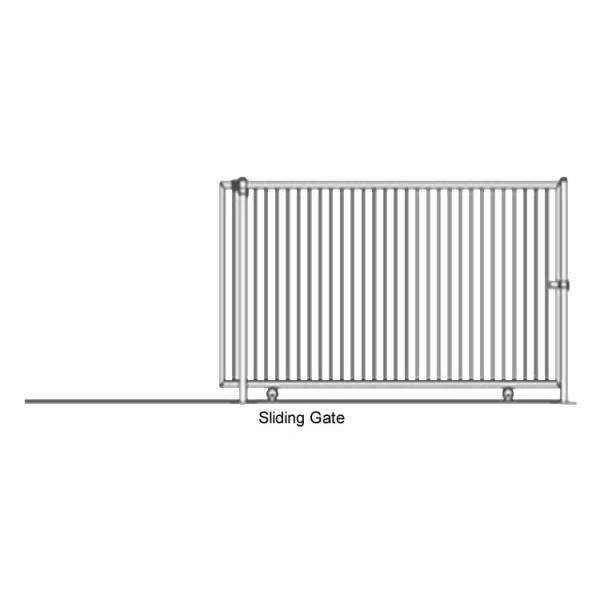 Sliding steel fence gate |
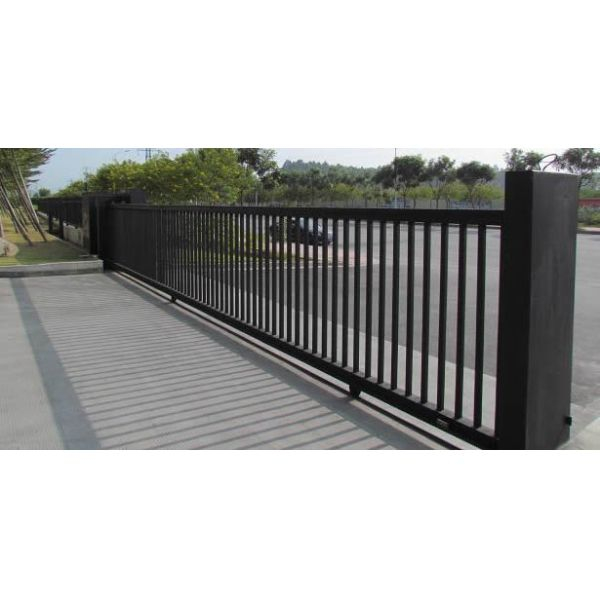 Sliding steel fence gates for factory access | 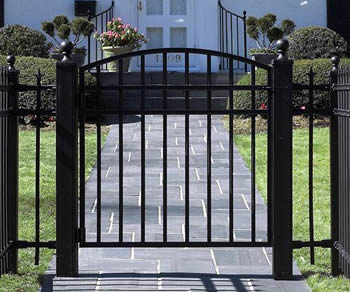 Steel gate detail view |
Type 1: Swing Gates
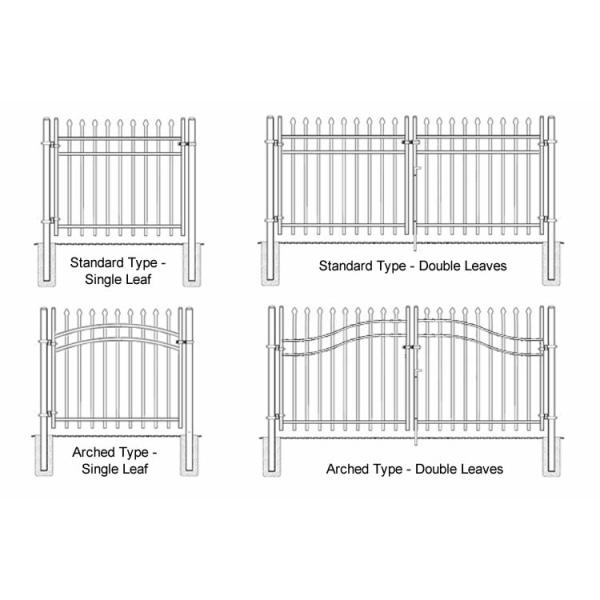
Swing gates are the most common entry solution for residential and commercial driveways. They can be built with single or double leaves, and the frame can be standard or arched. Swing gates are selected when you have enough internal clearance for the gate leaves to open safely without hitting vehicles, kerbs, slopes, or landscaping.
Swing Gates Details
Material: quality heavy gauge tubular steel
Structure: standard or arched type with single or double leaves
Finish: four layers of coatings including zinc coating (H.D), zinc phosphate, Epoxy coating and polyester powder coating from inside to outside.
Top: pressed spear, flat, rod top or ornamental style.
Pickets: 3/4″ × 18ga or 5/8″ × 18ga.
Post: 1-3/4″ × 14ga or 1-1/4″ × 16ga.
Rail: 1-7/16″ × 1-1/2″ × 14ga or 15/16″ × 1-1/4″ × 14ga.
Swing Gates Key Advantages
- Simple operation and familiar layout.
- Cost-effective for standard driveway openings.
- Easy to service hinges and latches compared to tracked systems.
- Works well for low to medium traffic sites when posts are specified correctly.
Swing Gates Downsides
- Requires clear swing space inside the property.
- Large leaves can catch wind and increase post stress.
- Can drag on sloped driveways without correct ground clearance planning.
Swing Gates Specifications Table
| Item | Options / Specification |
|---|---|
| Structure | Standard or arched; single leaf or double leaf |
| Top | Pressed spear / flat / rod / ornamental |
| Pickets | 3/4″ × 18ga or 5/8″ × 18ga |
| Posts | 1-3/4″ × 14ga or 1-1/4″ × 16ga |
| Rails | 1-7/16″ × 1-1/2″ × 14ga or 15/16″ × 1-1/4″ × 14ga |
| Rigidity | Welded intersections for high rigidity and no-sag control |
| Reinforcement | Optional corner gusset plates |
| Finish | Zinc (HD) + zinc phosphate + epoxy + polyester powder coat |
Type 2: Sliding Gates
Among the main types of steel fence gates, sliding gates are chosen when you need a wide opening but cannot spare swing space. They move parallel to the fence line and are widely used for factories and industrial sites because they can handle frequent vehicle access while keeping the entry line controlled. Sliding gates are also preferred when wind exposure makes large swing leaves harder to manage.
Sliding Gates Details
Material: quality heavy gauge tubular steel
Structure: welded structure with sliding wheels, single or double leaves
Finish: four layers of coating including zinc coating (H.D), zinc phosphate, Epoxy coating and polyester powder coating from inside to outside.
Top: pressed spear, flat top, rod top or ornamental style.
Height: 3-1/2′ to 10′.
Length: 8′ to 40′.
Sliding Gates Key Advantages
- No swing clearance required.
- Ideal for long openings and high traffic access points.
- More stable than wide swing leaves in windy locations.
- Easy to motorise for access control workflows.
Sliding Gates Downsides
- Track and rollers require cleaning and maintenance.
- Installation is more complex than swing gates.
- Debris can cause binding if drainage and cleaning are ignored.
Sliding Gates Specifications Table
| Item | Options / Specification |
|---|---|
| Structure | Welded gate frame with sliding wheels; single leaf or double leaf |
| Top | Pressed spear / flat / rod / ornamental |
| Height Range | 3-1/2′ to 10′ |
| Length Range | 8′ to 40′ |
| Movement | Sliding wheels (track-based sliding format) |
| Finish | Zinc (HD) + zinc phosphate + epoxy + polyester powder coat |
Other Popular Types of Steel Fence Gates
Cantilever Sliding Gates
Cantilever sliding gates are a sliding format that reduces track problems in muddy, dusty, or debris-heavy sites. Instead of running wheels directly through the opening zone, the gate is supported by a cantilever system that carries load through the support section. This reduces binding risk but increases the need for strong posts and foundations.
Pedestrian Gates
Pedestrian gates are designed for controlled foot traffic access. The main selection focus is preventing sag and keeping latch alignment clean under daily use. Strong posts, correct hinge selection, and tight picket spacing near the latch zone help keep the access point secure.
Manual vs Automated Gates
Automation improves convenience and access control, but it increases cycling frequency and applies consistent force. That means types of steel fence gates used with operators must have posts, hinges/rollers, and locks specified for higher duty cycles so the operator does not accelerate sag, binding, or misalignment.
How to Choose the Right Type of Steel Fence Gate
Space Rule
If you have internal swing clearance, swing gates are usually the simplest choice. If you do not have swing clearance, choose sliding or cantilever sliding gates.
Traffic Rule
If the gate will open many times per day, prioritize stronger posts, better hardware, and rigid welded structure so alignment stays stable and maintenance stays predictable.
Ground Condition Rule
If the ground is uneven or debris-prone, types of steel fence gates like cantilever sliding gates reduce track jamming. If you use a tracked sliding gate, plan drainage and cleaning so rollers do not bind.
FAQs
Which type is best for factories?
Sliding gates are widely used for factories because they control wide vehicle access without needing swing clearance and can be configured for frequent access cycles. For buyers comparing material strength and cost drivers behind gate frames and posts, Q195 steel is a common reference point in light-to-mid duty steel fabrication.
What causes “no-sag” gates to sag later?
Sag usually starts at posts and hardware. If post stiffness, hinge/roller selection, or installation alignment is under-specified, movement accumulates under repeated cycling until the latch line drops.
Which type is best for tight driveways?
Sliding gates are typically the most space-efficient because they move parallel to the fence line and do not require swing clearance.